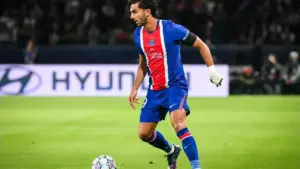
Willian Pacho is the least-discussed member of the best defence in Europe, and that is more or less how he seems to like it. Paris Saint-Germain have won the Champions League twice in a row with the Ecuadorian at the heart of the back line, and he has managed it without a signature moment, a viral celebration or a single week of being the story.
Here is who Willian Pacho is, how a teenager from the Ecuadorian coast ended up in Paris via Belgium and Germany, and why Luis Enrique built his defence around him.
Who is Willian Pacho?
Willian Pacho Tenorio is an Ecuadorian centre-back, born on 16 October 2001 in Quinindé, in the coastal province of Esmeraldas. He is left-footed, stands a shade over 1.80m, and wears the No.51 shirt in the 2026/27 PSG first-team squad.
He is not the tallest centre-back Paris have had, nor the most physically imposing. What he has instead is a combination that is genuinely rare at his age: recovery pace that lets a defence hold a high line without fear, and a tackling technique so clean that he barely gives fouls away. Defenders who are quick usually take risks. Defenders who take few risks are usually slow. Pacho is the exception on both counts.
From Independiente del Valle to Europe
Pacho came through Independiente del Valle, the Quito club that has become the most productive talent factory in South America and the model everyone else in the region now copies. He broke into the first team there and won a continental trophy before he turned 21.
The move to Europe came in 2022, and it was a sensible first step rather than a glamorous one: Royal Antwerp, in Belgium, a league that has become the standard proving ground for South American defenders. He spent one season there and it could hardly have gone better — Antwerp won the Belgian league title, their first in more than sixty years, and Pacho played as though the level had never troubled him.
The Eintracht Frankfurt season that changed everything
In the summer of 2023 Eintracht Frankfurt paid a modest fee to take him to the Bundesliga, and the season that followed is the one that put him on the radar of every elite recruitment department in Europe.
Pacho played virtually every minute of the league campaign in a Frankfurt side that was not built to sit deep, and he did it while conceding an extraordinarily low number of fouls — a statistic that circulated widely in the German press at the time and which explains a lot about how he defends. He does not grab, block or scramble. He arrives early, gets his body in front, and takes the ball.
For a recruitment team, that profile is enormously valuable. A centre-back who does not foul is a centre-back who does not concede free-kicks in dangerous areas, does not accumulate suspensions, and does not force his manager to substitute him at half-time because he is on a booking. Over a 60-game season, that reliability is worth more than the occasional spectacular intervention.
Why PSG signed Willian Pacho
Paris moved in the summer of 2024, paying a fee reported in the region of €40m. At the time it looked like a lot of money for a player most casual supporters could not have picked out of a line-up. Two years and two European Cups later, it looks like one of the better pieces of business the club has done in the modern era.
The tactical logic is straightforward once you understand how Luis Enrique wants Paris to play. This is a side that pushes its full-backs high, commits bodies forward, and defends with a line near the halfway mark. That approach only works if the centre-backs can win a footrace when the line is broken. If they cannot, the whole structure collapses the first time an opponent plays over the top.
Pacho is the insurance policy that makes the aggression possible. His left foot also matters more than it sounds: it gives Paris natural balance in the first phase of build-up, allowing them to open the pitch to the left without a defender having to shift the ball onto his stronger side first. Small detail, repeated eighty times a match.
Pacho and Marquinhos
His partnership with captain Marquinhos has been the spine of two European campaigns, and it works because the two men solve different problems. Marquinhos organises, reads the game a pass ahead, and does the talking. Pacho covers the ground behind him and cleans up what gets through.
The arrival of Illia Zabarnyi gave Luis Enrique a third high-level option, with Lucas Beraldo and Lucas Hernández also in the rotation, but Pacho’s place has not seriously been in question since he walked through the door.
What he has won at PSG
Quite a lot, in a short time. Pacho has been part of the squad that won the Champions League and then retained it, making Paris back-to-back European champions and the team everyone else in the competition is now measuring themselves against. Add domestic titles in France, the 2026 UEFA Super Cup — won 2-1 against Aston Villa in August — and the Belgian championship he collected at Antwerp on the way through.
He is also a fixture for Ecuador, a national side that has built its recent identity on exactly the qualities he brings: defensive discipline, physical quality and very little drama.
What Pacho actually does well
If you are watching him for the first time, three things are worth looking for.
The recovery run. When an opponent gets in behind, watch how quickly the gap closes and how rarely the challenge at the end of it is a desperate one. That is the single most valuable thing he does.
The front-foot step. Pacho defends forwards. Rather than dropping and inviting pressure, he steps out to meet the ball as it travels, which is how a high line survives contact with a good opponent.
The absence of noise. No theatrical appeals, few cards, little visible frustration. In a squad full of players who decide matches in the final third, having someone at the back who simply never has a bad week is its own kind of contribution.
Where he fits now
At 24, Pacho is entering what should be the strongest phase of a centre-back’s career, and he is doing it at a club chasing a third consecutive Champions League. Paris opened the Ligue 1 season with two 2-2 draws, away at Rennes and then at Lille, before the Champions League league phase begins with Les Parisiens as holders.
Whatever happens in that defence of the trophy, it will be built on the same foundation as the last two: a back line that can push up because the man covering behind it is quick enough to make it safe. Willian Pacho will not get the credit for it at the Parc. He does not appear to want it.
Squad and honours details are published by Paris Saint-Germain and Eintracht Frankfurt. Competition records are held by Ligue 1 and UEFA. All transfer fees are as reported.