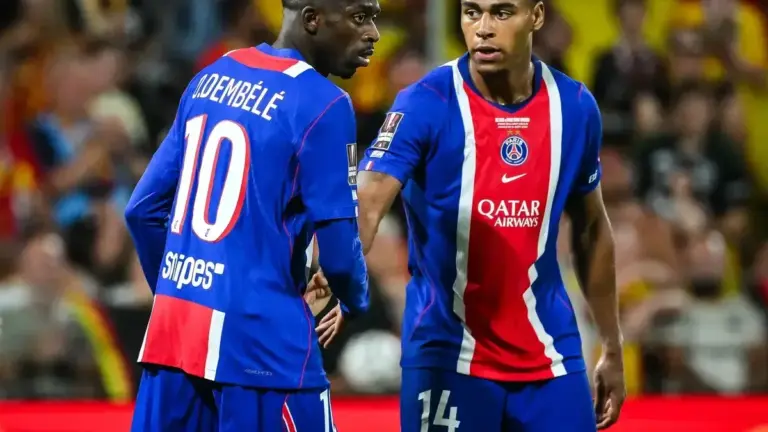
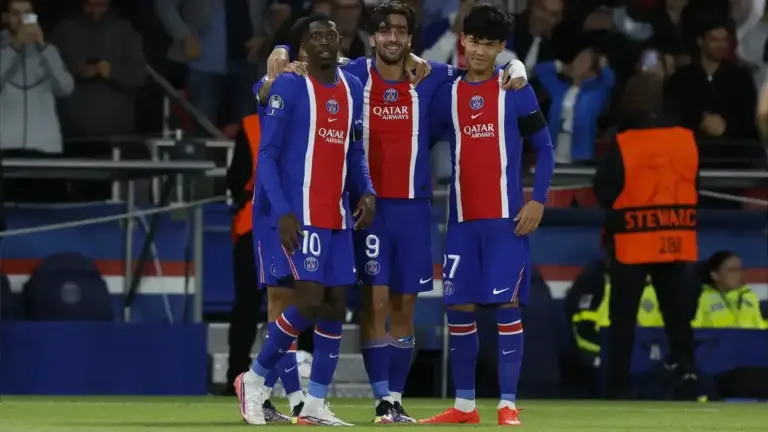
Few things unite a Parc des Princes crowd faster than a referee jogging towards a pitchside screen. VAR in Ligue 1 has been part of French football for long enough now that the theatre is familiar — the raised hands, the rectangle drawn in the air, the ninety seconds of silence before a goal is either confirmed or taken away.
The rulebook underneath it is far less familiar. Video review is a narrow tool with strict limits, and most of the arguments it generates come from supporters expecting it to do things it was never designed to do. Here is the plain-English version: what VAR is, the only four decisions it can touch, the threshold it has to clear, and how a review unfolds at a Paris Saint-Germain match.
What VAR actually is
VAR stands for Video Assistant Referee, and the important word is assistant. It is not a second referee and it does not overturn anything by itself. It is a match official watching television replays in a video operation room, with the power to tell the referee on the pitch that something has probably gone wrong.
The referee in the middle keeps the final call, every time. The video official can recommend a review, supply factual information, or say nothing at all — and in the overwhelming majority of incidents, saying nothing is the correct outcome.
The system is written into the IFAB Laws of the Game, the global rulebook that applies identically in Ligue 1, the Champions League and everywhere else the protocol is in use. France adopted it from the start of the 2018/19 season, several campaigns after the first experiments elsewhere in Europe.
The only four decisions VAR can review
This is the part most viewers get wrong. VAR cannot intervene in anything it fancies. The protocol restricts it to four match-changing categories:
- Goals — and any offence in the build-up to them, including offside, a foul, a handball or the ball having left the field.
- Penalty decisions — a penalty given that should not have been, or one missed that should have been.
- Direct red cards — whether a sending-off should have been shown, or whether one shown was wrong.
- Mistaken identity — when the referee cautions or dismisses the wrong player.
Everything outside those four boxes is untouchable. A soft free-kick in midfield stands. A corner wrongly awarded stands. Crucially, a second yellow card is not reviewable — only straight reds are — which is why a player can be dismissed for a second booking that replays show to be harsh, and nothing whatsoever can be done about it.
The “clear and obvious error” threshold
Even inside those four categories, VAR is not supposed to referee the game again. It may only step in for a clear and obvious error, or for a serious incident the officials missed entirely.
That phrase is doing enormous work. If the on-field decision is defensible — a marginal foul, a contact that two honest referees could see differently — the protocol requires the video official to leave it alone, even if they personally disagree. The bar is not “was the referee right?” but “was the referee obviously wrong?”
It is the single biggest source of frustration in French football, because a decision can be simultaneously wrong and un-reviewable. It is also the reason the system works at all: lower the threshold and every match becomes a three-hour tribunal.
How a review happens at a Ligue 1 match
There are two routes, and knowing which is which explains why some checks take ten seconds and others take two minutes.
Factual decisions — offside, whether the ball crossed a line, whether an offence happened inside or outside the box, mistaken identity — are settled by the video official alone. There is nothing subjective to weigh, so the information is relayed and the referee acts on it.
Subjective decisions — was that a foul, was it violent conduct, was the handball deliberate — trigger an on-field review. The referee signals the television rectangle, goes to the referee review area at the side of the pitch, watches the footage and then makes the call personally. That walk is not a formality; it exists specifically so that the human in charge of the match owns the outcome.
Play is not restarted until the process finishes, and an incident that occurred before a stoppage can still be punished once the review is done.
Who runs it in France
Refereeing in France sits with the French Football Federation, which appoints, trains and assesses the officials. The competition itself — the fixture calendar, the broadcast arrangements, the operational side of a matchday — is run by the LFP. Video officials are qualified referees drawn from the same pool as the men in the middle, not a separate class of technician.
That split matters when a controversial call lands. Complaints about a decision go to the federation’s refereeing structure; complaints about how a match was staged go to the league. Clubs routinely aim at the wrong one.
Why it feels different in Europe
The protocol Paris play under in the Champions League league phase is the same protocol, administered by different people with different technology. UEFA has used semi-automated offside technology in its competitions, which speeds up the tightest calls considerably and removes much of the line-drawing that makes domestic offside checks so painful to watch.
The laws do not change across the border. The tools, the personnel and the appetite for intervention do — which is why the same challenge can feel reviewed differently on a Wednesday night than it did on the Sunday.
What it means for Paris
PSG are, structurally, one of the sides video review affects most. A team that spends most of a Luis Enrique match camped in the opposition half accumulates penalty appeals, tight offsides against a high line and late goals in crowded boxes — the exact incidents the protocol exists to check. More Paris goals go to a check than most clubs’ do, simply because Paris create more of them in the situations VAR examines.
The other half of the ledger is the high defensive line Les Parisiens play. Offside is a factual decision, so those calls are resolved without a monitor, and they are resolved by margins invisible to anyone in the stands. For the competition all of this takes place in, our guide to how Ligue 1 works covers the format itself.
A note on the details
IFAB reviews the Laws of the Game annually and the VAR protocol has been amended more than once since its introduction, while the specific technology deployed in any given competition — goal-line systems, offside automation, in-stadium announcements of decisions — is a matter for the organiser rather than for the laws themselves. The structure described above is how video review is designed to function; for the current season’s exact operating regulations, the LFP’s own published documents and the IFAB Laws of the Game are the only authorities worth quoting.
For more on the machinery behind French football, read our explainers on the Coupe de France and on Le Classique.