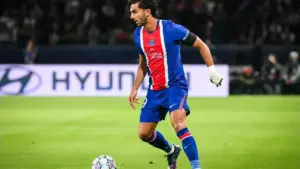
Illia Zabarnyi turns 24 today, and he does so as a European champion, a Ukraine international with a caps tally most defenders his age can only envy, and the man wearing the No.6 shirt for Paris Saint-Germain. Not a bad way to spend a birthday.
He is also, arguably, the least-discussed member of the PSG back four — which is exactly how centre-backs like it. Here is who Illia Zabarnyi is, how he got to the Parc, and what he actually does in a Luis Enrique side.
Who is Illia Zabarnyi?
Illia Zabarnyi is a Ukrainian centre-back, born on 1 September 2002 in Kyiv. He is right-footed, tall, and built along the lines modern football demands of a defender: quick enough to defend a high line, comfortable enough on the ball to start attacks rather than simply end them.
He came through the academy at Dynamo Kyiv and did not hang about. He was in the first team as a teenager, won a Ukrainian league title before he turned 19, and made his senior international debut for Ukraine at 18 — a promotion that usually signals either desperation or a genuinely exceptional prospect. In Zabarnyi’s case it was clearly the latter, because he never gave the shirt back.
From Kyiv to the Premier League
In January 2023 he joined Bournemouth, a move that raised eyebrows in England mainly because of the price — a fee reported at around £20m for a 20-year-old from the Ukrainian league was, at the time, considered bold.
It aged extremely well. Zabarnyi spent two and a half seasons on the south coast and grew into one of the more reliable young centre-backs in the division, playing in a high-pressing, aggressive system that asked its defenders to hold a line near halfway and cover enormous amounts of grass behind it. That is precisely the education a player needs before joining a side that defends the same way, only against better opponents.
The Premier League also did something less measurable for him: it hardened him. Ukrainian league football does not routinely ask a young defender to deal with a physically enormous striker every week for nine months. English football does, and he came through it.
Why PSG signed Illia Zabarnyi
Paris moved for him in the summer of 2025, paying a fee reported at around €63m — serious money, and a statement of intent about how the club intended to build its defence for the next decade rather than the next season.
The logic was straightforward. Marquinhos has been magnificent for more than a decade, but he was on the wrong side of 30 and no succession plan lasts forever. Willian Pacho had arrived and settled quickly. What Paris lacked was a right-sided centre-back of genuine international quality who could be signed young and kept for years.
There was also a footedness problem to solve. Pacho is left-footed; a right-footed partner beside him balances the build-up, opens the diagonal pass out to the right and stops the whole defence tilting one way. Zabarnyi does that job naturally.
What he actually does in Luis Enrique’s system
Everything about Luis Enrique’s 4-3-3 is built on a defensive line that pushes high, squeezes the pitch and refuses to sit deep. It is a system that wins matches and, when it goes wrong, loses them spectacularly. It requires centre-backs who can defend fifty yards of open space in a straight sprint, and who can be trusted with the ball in tight areas while a press closes in.
Zabarnyi’s value is that he does both parts without drama. He is a recovery defender first — the one who eats up ground when a ball is played in behind — and a composed passer second. He is not a shouty, chest-thumping centre-half. He reads a situation early and takes a step that means the tackle never has to be made.
In a back four that also contains Nuno Mendes and Achraf Hakimi — two full-backs who are effectively attackers with defensive duties attached — having a centre-back who covers quietly and rarely needs help is worth a great deal.
What he has won at PSG
Rather a lot, rather quickly. Zabarnyi arrived in the summer after Paris won their first Champions League and was part of the squad that retained it in 2025/26, making him a European champion inside a year of joining. He also has a 2026 UEFA Super Cup medal from the 2-1 win over Aston Villa.
For a player who was in the Ukrainian Premier League four seasons ago, that is a considerable career acceleration. It also means the standard he will now be judged against is unforgiving: at Paris, retaining trophies is the baseline rather than the achievement.
The 2026/27 season and what comes next
Paris have started this Ligue 1 campaign with two draws, 2-2 away at Rennes and then 2-2 at Lille, which is not the tempo the 2026/27 squad intends to keep. Paris habitually start slowly and finish with silverware, but the defensive numbers from those two matches will not have pleased the manager.
Competition for the two centre-back places is real: Marquinhos, Pacho, Lucas Beraldo and Lucas Hernandez are all there, and Luis Enrique rotates more than most managers at this level. Zabarnyi’s route to being an automatic pick is the one he has taken everywhere else — be quietly excellent for long enough that leaving him out becomes the harder decision.
The bigger stage arrives with the Champions League league phase, where Paris begin as holders and where a defence that concedes twice a game does not go far. If Paris are to make it three in a row, the 24-year-old in the No.6 shirt will be a very large part of the reason.
Squad numbers and transfer details are listed by Paris Saint-Germain. Competition records are held by Ligue 1 and UEFA, with international appearance records maintained by the Ukrainian Association of Football.