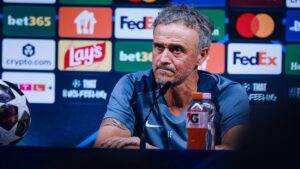
Ask a neutral who the best manager in world football is right now and a lot of them will say Luis Enrique. He is the man who took Paris Saint-Germain from perennial European nearly-men to back-to-back Champions League winners, and he did it by tearing up the one thing everybody assumed Paris could never live without: the superstar.
This is the full profile — who he is, what he won before Paris, how he rebuilt the club, and what he is trying to do next.
Who is Luis Enrique?
Luis Enrique Martínez García, born in Gijón in northern Spain in May 1970, has been the Paris Saint-Germain head coach since July 2023. In his first three seasons he won three French championships and the Champions League twice, retaining it in 2025/26 to make Paris the holders going into this campaign. He also won the 2026 UEFA Super Cup, beating Aston Villa 2-1.
He is, in other words, the most successful manager in the club’s history, and it is not particularly close.
The player: Real Madrid, then Barcelona
Long before the touchline, Luis Enrique was a footballer with the rare distinction of having played for both Spanish giants. He came through at his hometown club Sporting Gijón, moved to Real Madrid in 1991, and then — on a free transfer in 1996, which did not go down well in the capital — joined Barcelona, where he spent eight years and became a captain.
He was not a specialist. He played on either wing, in central midfield, at full-back and occasionally in attack, and he ran until the game stopped. Sixty-two caps for Spain followed, including the 1994 World Cup quarter-final against Italy in which Mauro Tassotti broke his nose with an elbow and Luis Enrique carried on bleeding through the closing minutes. It is still the image most Spaniards reach for when they describe him.
The coach before Paris
His management career started at Barcelona B, then took in a season at Roma and a season at Celta Vigo. The Roma year was difficult and the Celta year was quietly excellent, and it was the second that convinced Barcelona to hire him for the first team in 2014.
What followed was one of the great short reigns. In 2014/15 his Barcelona side won La Liga, the Copa del Rey and the Champions League — a treble, built around the Messi-Suárez-Neymar front three. Across three seasons he won nine trophies before stepping away in 2017, citing exhaustion.
He then took the Spain job, a spell interrupted by the illness and death of his nine-year-old daughter Xana in 2019. He returned to the role later that year and rebuilt the national side around young technicians rather than reputations, reaching the semi-finals of Euro 2020 before leaving after the 2022 World Cup.
How Luis Enrique changed PSG
He arrived in Paris in the summer of 2023, at the exact moment the club’s old model collapsed. Lionel Messi had gone, Neymar left within weeks, and Kylian Mbappé departed a year later. A generation of PSG teams had been assembled as galleries of individuals. Luis Enrique was hired to build a team instead.
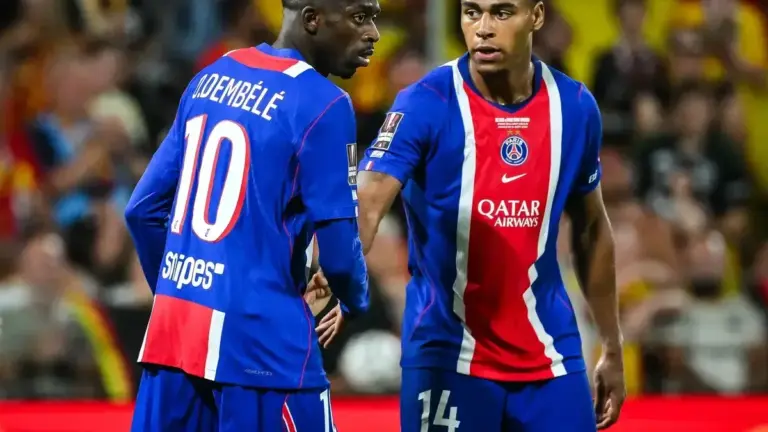
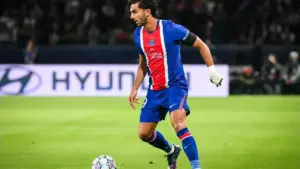
The football that resulted is aggressive and possession-heavy: a very high defensive line, relentless counter-pressing, inverted full-backs stepping into midfield, and a refusal to let any single player become bigger than the structure. Ousmane Dembélé won the Ballon d’Or under him after being asked to press from the front as hard as he attacked. Vitinha and João Neves became the metronomes. Nuno Mendes and Achraf Hakimi were unleashed.
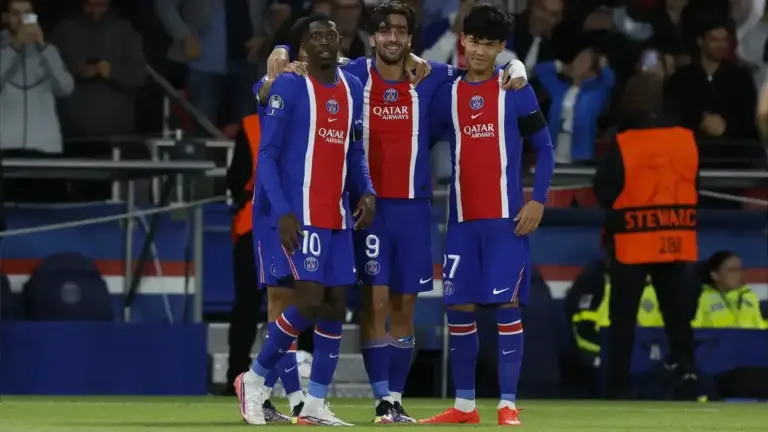
The reward was the trophy Paris had chased for over a decade. PSG won the Champions League in 2024/25 and then retained it in 2025/26 — you can find the full European record in our guide to how many Champions Leagues PSG have won. Domestically, the three consecutive titles he has added took the club to a record 14 French championships; the complete list is in our rundown of every PSG Ligue 1 title.
The style, in plain terms
- Positional play. Players occupy zones rather than roles, and rotate constantly. It is why PSG’s shape can look different three times in one attack.
- A brutally high line. Paris squeeze the pitch and accept the risk of being run in behind. It requires a goalkeeper comfortable well outside his box.
- Rotation without sentiment. Nobody is guaranteed a start, including Ballon d’Or winners. He has repeatedly left big names out and defended it as squad management rather than punishment.
- Youth trusted early. Warren Zaïre-Emery, Senny Mayulu and Désiré Doué have all been given serious minutes in serious games.
He is also, by some distance, the most combative interview in Ligue 1. He plays down trophies he has just won, argues with reporters he thinks are asking lazy questions, and refuses to discuss transfers. It is deliberate: the noise stays outside the dressing room.
Luis Enrique’s PSG in 2026/27
The fourth season began with the awkward bits first. Paris lost the Trophée des Champions 1-0 to Lens, then opened the Ligue 1 defence with a 2-2 draw away at Rennes before the Super Cup win over Aston Villa steadied things. The squad has been reshaped again over the summer: Ferran Torres arrived from Barcelona, Maghnes Akliouche from Monaco, Mika Godts from Ajax and Lucas Digne from Aston Villa, while Gonçalo Ramos, Randal Kolo Muani and Lee Kang-in all left. The full group is set out in our PSG squad guide for 2026/27, led on the pitch by captain Marquinhos.
The target is the one nobody in the modern era has managed: a third consecutive Champions League. Paris enter the league phase as holders. Reports in France have also linked Luis Enrique with a long-term contract extension in Paris, though nothing on that has been confirmed by the club, and it is worth treating the specific dates attached to those stories with caution.
Why he matters to Paris
Every previous PSG project was defined by who it signed. This one is defined by how it plays. That is the actual change Luis Enrique delivered, and it is why a club that once needed a Ballon d’Or winner in every window now sells forwards and keeps winning.
He remains, in his own description, an obsessive — a man who rides his bike up mountains for fun and runs marathons in his spare time. Paris have finally found a manager whose appetite matches their ambition.
Fixtures and results are confirmed by Ligue 1, with squad and club information published by Paris Saint-Germain and European competition detail at UEFA.