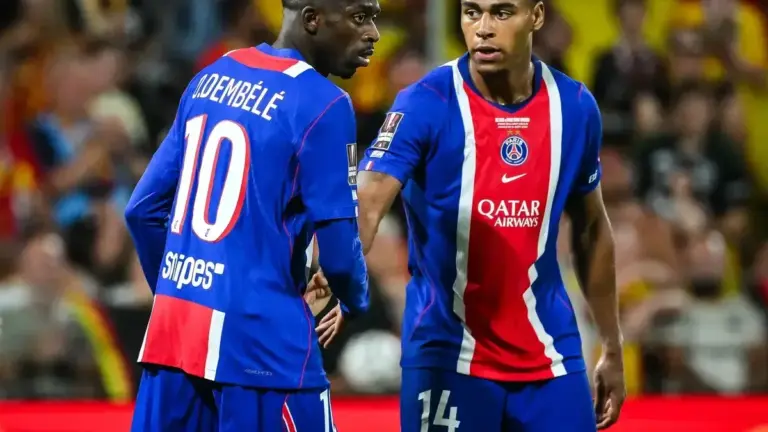
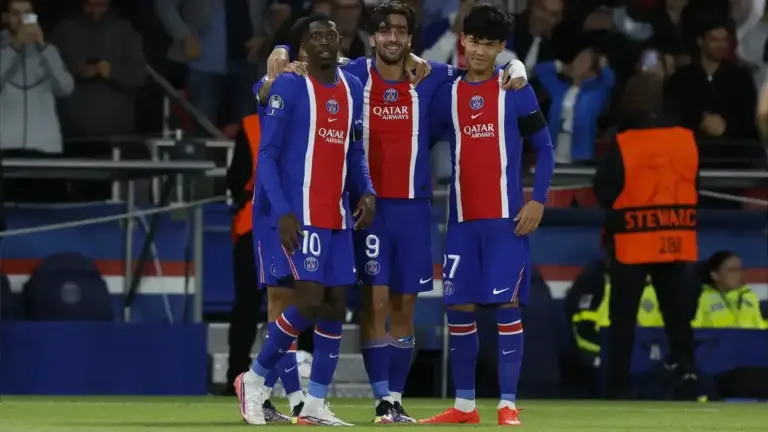
The Parc des Princes is not the biggest stadium in France, or the newest, or the most comfortable. It is simply the loudest room in French football and the place Paris Saint-Germain have called home for more than fifty years. This is the full guide: capacity, history, the stands, how to get there and why the club’s relationship with the building has become one of the longest-running stories in Paris.
Parc des Princes capacity and key facts
The Parc des Princes holds just under 48,000 — the official figure is 47,929. It sits in the 16th arrondissement in the south-west of the city, at 24 Rue du Commandant Guilbaud, hard against the Boulevard Périphérique. Part of the ring road actually runs underneath the structure, which tells you a great deal about how tightly the ground is wedged into the city.
The current stadium was inaugurated on 4 June 1972 and was designed by the French architect Roger Taillibert. It is the third ground on the site: the original Parc des Princes opened in 1897 as a cycling venue, and a second version followed in 1932. Paris Saint-Germain, founded in 1970, moved in permanently in 1974 and have never left.
Why the Parc feels different
Taillibert’s design is the reason. The Parc is a fully enclosed bowl with no running track, no gap between the crowd and the pitch and steep, close stands that trap noise rather than letting it escape into the night. The exposed concrete ribs that hold the roof up are the building’s signature, and while they have not aged into anyone’s idea of beautiful, they work: on a European night the Parc sounds twice the size it is.
That intimacy is precisely what modern stadium design usually trades away for capacity and corporate space. It is also why supporters have been so resistant to the idea of moving.
The stands, explained
- Tribune Auteuil (south) — the ultras end, and the engine of the atmosphere. The Collectif Ultras Paris have occupied it since 2016.
- Tribune Boulogne (north) — historically the other hardcore end, and for decades the source of the rivalry between the two curves that shaped — and at times disfigured — the club’s supporter culture.
- Tribune Paris (west) — the main side, housing the presidential box, the media positions and the dugouts.
- Tribune Borelli (east) — the opposite flank, named after former club president Francis Borelli.
The terrace culture at the Parc has a complicated recent history. In 2010 the club’s Plan Leproux effectively dissolved the organised supporter groups after years of violence between the ends, and for six seasons the ground was noticeably quieter. The Collectif Ultras Paris took over Auteuil from 2016 and the noise came back with them. Anyone who has been to a Classique since will confirm it worked.
What else the Parc des Princes has hosted
Long before PSG existed, this was one of the most important sporting venues in Europe. The Tour de France finished at the Parc des Princes for decades. The France national football team played here until the Stade de France opened in 1998, and the France rugby union side used it as their home for the Five Nations until the same move.
It has staged three European Cup finals, in 1956, 1975 and 1981, along with several Cup Winners’ Cup finals. It hosted the final of Euro 1984, when France beat Spain to win their first major trophy. It was a venue at the 1998 World Cup, at Euro 2016 and at the Paris 2024 Olympic football tournament. For a ground of fewer than 50,000 seats, the honours list is remarkable.
Getting to the Parc des Princes
The Parc is well served by the Métro. Porte de Saint-Cloud on line 9 is the closest and busiest option, with Exelmans (also line 9) and Porte d’Auteuil (line 10) both within a walk. There is essentially no matchday parking worth attempting, and the Périphérique around the ground is not a road you want to be sitting on at 20:15.
Ticketing, hospitality and stadium-tour availability are all handled through the club — check psg.fr for current listings, as availability for Ligue 1 and Champions League fixtures is managed separately and sells out quickly.
The ownership question
Here is the part that never quite goes away. Paris Saint-Germain do not own the Parc des Princes. The stadium belongs to the City of Paris, and the club plays there as a tenant. PSG have made no secret of wanting to buy the ground outright in order to expand and redevelop it, and the city has publicly declined to sell.
That stand-off has run for years and has repeatedly pushed the club into exploring alternatives, including a possible move elsewhere in the region. Nothing has been settled, and supporters have consistently made clear that the Parc is not something they consider negotiable. Treat any reported deadline in this saga with caution; it has produced a lot of headlines and very little movement.
The Parc in 2026/27
The building is now the home of the European champions. Paris won the Champions League in 2024/25 and retained it in 2025/26, and Luis Enrique’s side begin this season defending the trophy in the league phase while chasing a 15th French championship. The Parc will also stage the home half of a Ligue 1 campaign led by captain Marquinhos, with the squad rebuilt again over the summer as Maghnes Akliouche, Ferran Torres, Mika Godts and Lucas Digne all arrived — the full list is in our 2026/27 squad guide.
Fifty-plus years in, the argument about the Parc des Princes is the same as it has always been. It is too small for a club of this size, awkward to expand, hemmed in by a ring road and owned by somebody else. It is also, on the right night, the best atmosphere in France. Paris have spent a decade and a half trying to buy their way to the top of European football and have finally got there. The one thing they still cannot buy is the ground they did it in.
Fixtures and kick-off times are confirmed by Ligue 1, with venue and ticketing information published by Paris Saint-Germain.