The PSG formation question is the one that comes up every time Paris Saint-Germain take the pitch, and the answer is both simple and slippery: on paper, Luis Enrique lines his side up in a 4-3-3. In practice, that 4-3-3 rarely stays a 4-3-3 for longer than about fifteen seconds at a time. This is the shape that delivered back-to-back Champions League titles, and understanding it is the difference between watching Paris and actually following them.
Here is how it works, position by position, and why it looks so different from the Paris of a decade ago.
The PSG formation on paper: a 4-3-3 with no passengers
Start with the base. A goalkeeper who is expected to play as an eleventh outfielder. Two centre-backs comfortable defending an enormous amount of open grass. Two full-backs who spend more time in midfield than on the touchline. Three central midfielders who rotate rather than hold fixed positions. And a front three of technicians rather than target men.
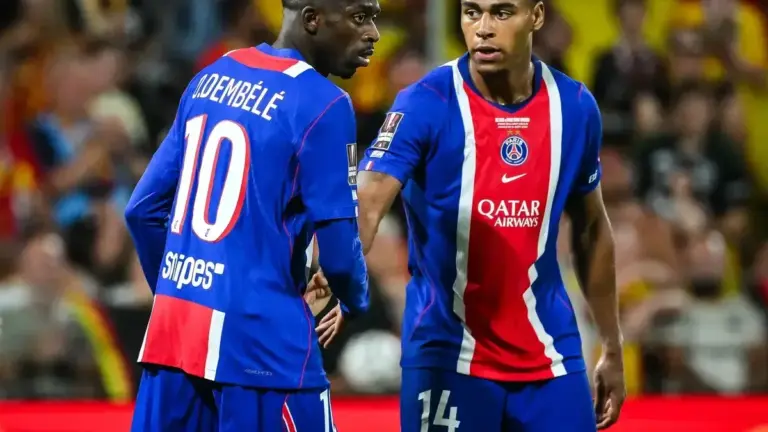
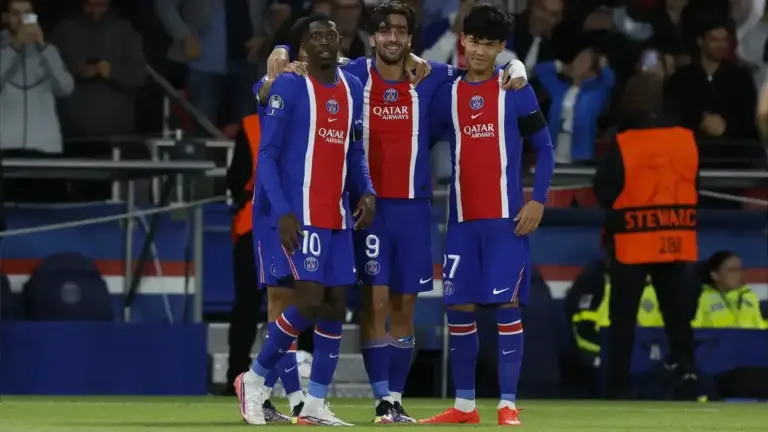
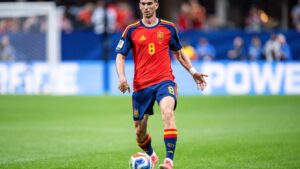
The numbers on the shirts tell you most of it. In the 2026/27 first-team squad, Paris carry no orthodox No.9 in the traditional sense — Ferran Torres wears the 9, but the centre-forward role in this side is a role for a forward who drops, drifts and pulls defenders out of position, not one who waits in the box.
The goalkeeper and the back four
Lucas Chevalier starts from the premise that the goalkeeper is where the attack begins. Everything Paris do under Luis Enrique depends on the team being able to play out from their own penalty area under pressure, and that requires a keeper who invites the press rather than avoiding it.
In front of him, captain Marquinhos anchors a centre-back department that also contains Illia Zabarnyi, Willian Pacho and Lucas Beraldo. Their job description is unusual: defend a high line, cover the space behind an aggressive press, and be secure enough on the ball to break the first line of an opponent’s structure with a pass rather than a clearance.
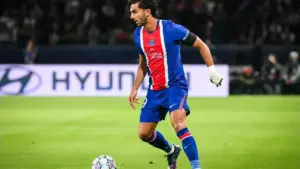
The full-backs are where the shape genuinely bends. Achraf Hakimi on the right and Nuno Mendes on the left are two of the most attacking full-backs in Europe, and Luis Enrique uses them asymmetrically — one tucking inside to create an extra central passing lane, the other holding the width to stretch the pitch. Lucas Hernandez and Lucas Digne, the latter arriving from Aston Villa this summer, provide the more conservative version of the same jobs.
The midfield three: the real engine
If there is one place to look to understand this team, it is the middle.
Vitinha is the metronome — the player who sets the tempo, receives under pressure and decides when Paris go slow and when they go through you. João Neves is the ball-winner and the accelerator, a midfielder whose pressing range covers an absurd amount of ground. Fabián Ruiz brings the left-footed control and the diagonal passing that unlocks a compressed defence, and Warren Zaïre-Emery offers the same profile with more direct running.
What makes the trio work is rotation. Positions in this midfield are reference points, not addresses. One drops beside the centre-backs, one pushes into the pockets between an opponent’s midfield and defence, one covers the space they both vacate — and which player does which changes constantly within a single passage of play. It is the hardest part of the system to coach and the reason Paris so often look like they have an extra man.
Maghnes Akliouche, signed from Monaco this summer, adds a genuinely different option here: a creator comfortable operating between the lines rather than beside them. Senny Mayulu and Dro Fernández represent the academy pathway into the same role.
The front three: interchange, not positions
Paris attack with three forwards who almost never end a move where they started it.
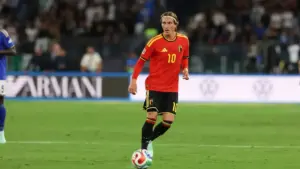
Khvicha Kvaratskhelia is the isolation specialist — give him a touchline and a defender and something usually happens. Ousmane Dembélé, the Ballon d’Or winner who wears the 10, has been used centrally as much as wide, dropping into midfield to receive and dragging centre-backs into decisions they do not want to make. Désiré Doué is the youngest of the group and arguably the most positionally fluid of the lot.
Ferran Torres, signed from Barcelona in the summer, gives Luis Enrique a forward he knows intimately from his Spain years and who fits the brief: mobile, press-resistant, willing to occupy a centre-back without needing the ball played to his feet. He marked his league debut at Rennes with two goals. Mika Godts, in from Ajax, is the newest wide option.
Out of possession: the pressing rules
The formation matters far less than what Paris do the moment they lose the ball. The instruction is immediate, aggressive counter-pressing, high up the pitch, with the defensive line pushed to the halfway line and beyond to keep the team compact.
That approach carries obvious risk. Play a line that high and any ball over the top becomes a foot race, which is why Paris need centre-backs with recovery pace and a goalkeeper willing to sweep. The trade-off Luis Enrique has accepted is straightforward: concede the occasional clean chance in exchange for winning the ball back forty yards from the opposition goal, over and over again, for ninety minutes.
It is exhausting to play against, and it is exhausting to play. That is why squad rotation is not a luxury in this system but a structural requirement, and why the manager guards his players’ physical condition so jealously across a season that includes a Champions League league phase of eight fixtures before the knockout rounds even start.
Why the shape suits this squad
Look at what Paris have assembled and the logic becomes obvious. There is no single superstar the whole structure serves. Instead there are eleven technically excellent, physically relentless footballers, none of whom is exempt from the defensive work.
That is the genuine break from the Paris of the Neymar–Mbappé–Messi years, when the front line was largely excused from pressing and the team was built to feed it. Luis Enrique’s Paris is the opposite proposition: a collective in which the most gifted attackers work hardest without the ball. It won two European Cups in two seasons, which is the only argument that ultimately counts.
How to read a PSG line-up
A practical tip for watching Les Parisiens: ignore the graphic. The published XI will tell you 4-3-3, and within a minute of kick-off it will be something else — a 3-2-5 in settled possession, a 4-4-2 press when the opponent has the ball in a wide area, a back three when one full-back inverts.
Watch the full-backs instead. Where Hakimi and Nuno Mendes position themselves tells you what Luis Enrique wants from that specific match, more reliably than any formation label. And watch Vitinha’s first three touches. If he is receiving freely between the lines, Paris are about to have a comfortable evening at the Parc.
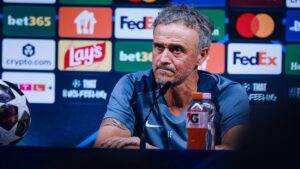
Squad and appearance detail is published by Paris Saint-Germain, with competition and fixture detail confirmed by Ligue 1 and UEFA. For more on the manager behind the system, read our profile of Luis Enrique.