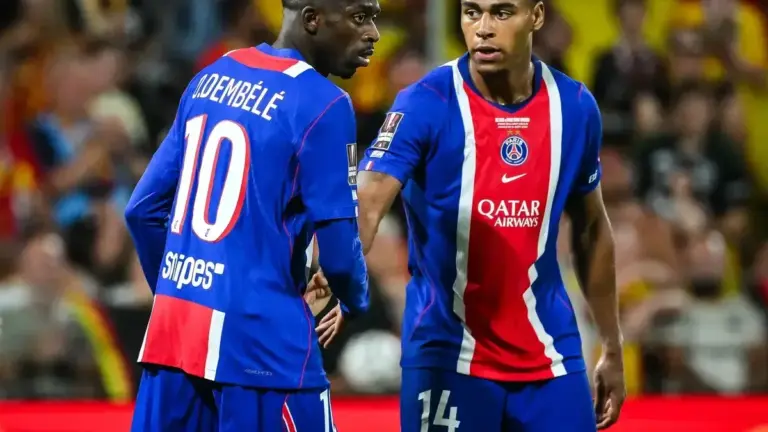
Désiré Doué is the player Paris Saint-Germain supporters point to when they want to explain what this team became.
He is 21 years old, he wears No.14, and he has already done the single most memorable individual thing any Paris player has done in a European final.
This is the full profile of Desire Doue – where he came from, what he actually does on a pitch, and why Luis Enrique trusts him with the biggest nights.
Who is Desire Doue?
Désiré Doué is a French forward, born on 3 June 2005 in Angers, who plays for Paris Saint-Germain and France.
He wears No.14 in the 2026/27 first-team squad and is one of the most versatile attackers in Luis Enrique’s group — capable off either flank, behind the striker, or as a second No.8 when Paris want an extra body in midfield.
He is not the quickest forward at the club and he is not the strongest. What he has instead is an unusually calm relationship with the ball in tight spaces: a low centre of gravity, both feet, and the composure to slow a move down for half a second while everyone around him panics. In a squad full of players who accelerate, Doué is the one who decelerates — and that is often the more valuable skill.
Rennes: the academy, and the brother
Doué came through the academy at Stade Rennais, the club he joined as a boy and where his older brother Guéla, a right-back, came through alongside him. Both brothers were fast-tracked, and both made senior debuts in Brittany before either was old enough to vote.
Désiré was the one who broke through first and hardest. He was handed senior minutes in Ligue 1 as a 17-year-old and quickly became the sort of player rival scouts write two reports about — one on what he was doing, one on what he might do. Rennes have a long history of developing France internationals and selling them well; Doué became the most expensive of them.
Eligible for Ivory Coast through family, he committed to France, and has moved steadily up the age groups and into the senior squad since.
The move to Paris
Paris signed him in the summer of 2024, in a window where the club had made a deliberate strategic turn. The Kylian Mbappé era had ended and the recruitment brief had changed with it: younger, cheaper relative to ceiling, coachable, and bought to fit a system rather than to sell shirts. Doué was the clearest expression of that brief. The fee, reported at around €50m, looked steep for a teenager with one strong Ligue 1 season behind him.
It does not look steep now.
His first season was a gradual accumulation — minutes here, a start there, a substitute appearance that changed a game — rather than an instant coronation. Luis Enrique has always preferred to feed young players into a team slowly, and Doué was fed in slowly. Then came May.
The Champions League final that changed everything
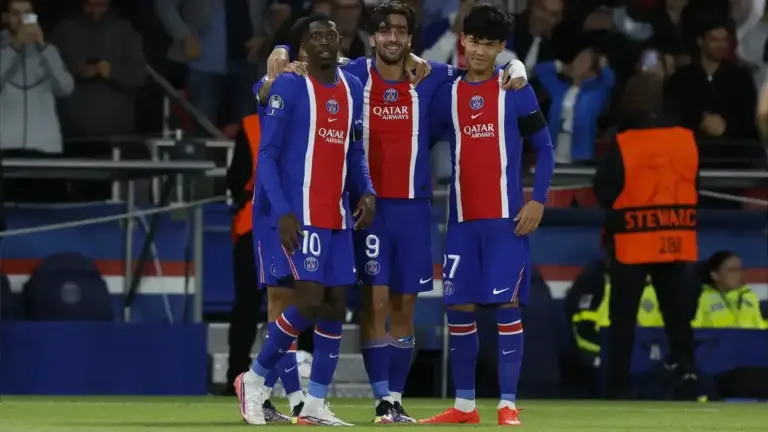
In the 2025 Champions League final in Munich, Paris beat Inter Milan 5-0 to win the trophy for the first time in the club’s history. Doué scored twice and set up another. He was 19.
It remains the defining performance of his career and one of the great individual displays in a European final. He was named the competition’s young player of the season, and the Paris support has treated him differently ever since — not as a prospect, but as someone who has already delivered on the biggest stage there is. Paris then retained the trophy the following season, making Luis Enrique’s side back-to-back European champions.
What Desire Doue actually does in this team
In Luis Enrique’s 4-3-3, the wide forwards are asked to do two contradictory things: hold width to stretch a back line, then arrive centrally when the ball travels. Doué is unusually good at the second part. He drifts inside off the right onto his stronger left foot, or plays off the left and comes short, and his best moments tend to come between the lines rather than out by the touchline.
That flexibility is why he starts big games ahead of more conventional wingers. With Ousmane Dembélé and Khvicha Kvaratskhelia both in the squad, minutes on the flanks are fiercely contested — but Doué can play in any of the three forward roles and in the right-sided midfield slot, which means he is rarely the man left out.
He is also a genuinely willing defender, which matters more to this coaching staff than it does at most clubs. Paris press in coordinated blocks and a forward who switches off breaks the whole structure. Doué does not switch off.
2026/27: where he stands now
Doué scored in the 2026 UEFA Super Cup as Paris beat Aston Villa 2-1 to add another trophy to the cabinet, and he was on the scoresheet for France at the 2026 World Cup over the summer. He started the Ligue 1 trip to Lille in matchweek two, a game that finished 2-2 after a last-touch header from captain Marquinhos, and was replaced at half-time by Kvaratskhelia as Luis Enrique reshaped the attack.
That is worth sitting with, because it says something about where he is. Being substituted at half-time in Lille is not a demotion; Luis Enrique makes that kind of change constantly, and he made a similar call on Dembélé at Rennes the week before. Doué is a starter in a squad where almost nobody is guaranteed 90 minutes.
The competition around him has only intensified. Ferran Torres arrived from Barcelona for €48.5m and Mika Godts from Ajax for around €45m, while Maghnes Akliouche came in from Monaco. Paris have deliberately built a forward line where four or five players can start any given match. Doué’s answer to that is the one thing nobody else in the squad can point to: two goals in a Champions League final.
What comes next for Desire Doue
The honest assessment is that Doué has not yet had the season where he is unambiguously one of the best attackers in Europe across ten months rather than one night. That is the step in front of him, and at 21 there is no reason he cannot take it. He has the technique, he has the tactical intelligence Luis Enrique’s system demands, and he has already proved he does not shrink when the stage gets absurdly large.
For Paris, he is close to the ideal modern signing: bought young, developed further in-house, adaptable enough to survive every squad reshuffle, and now a fixture in the France setup. The club spent a decade buying finished superstars. Doué is what happens when they build one instead. There is a reason the Parc sings his name.
Squad and player information is published by Paris Saint-Germain, with fixtures and results confirmed by Ligue 1 and European competition detail at UEFA.