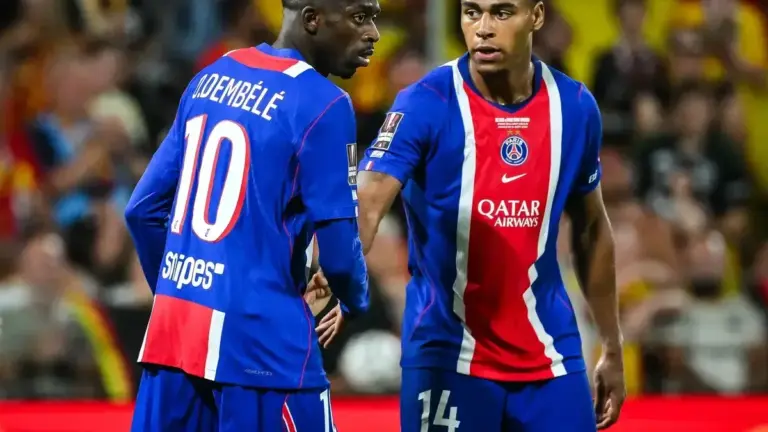
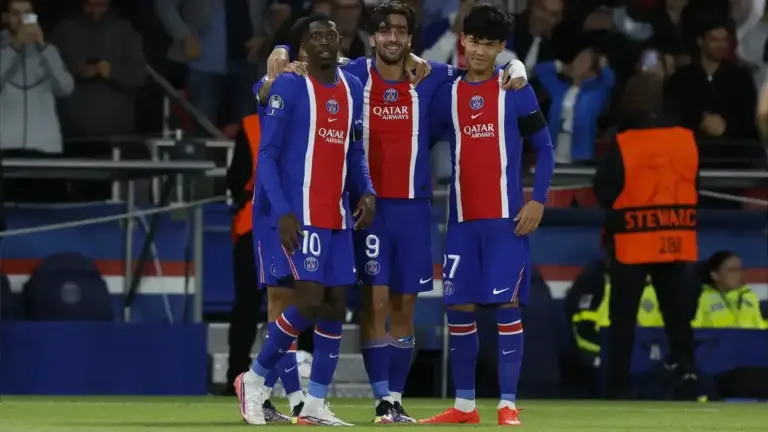
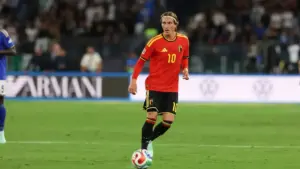
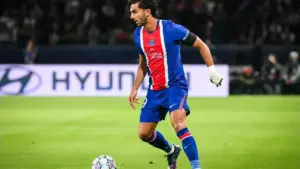
Ousmane Dembele is the reason Paris Saint-Germain stopped needing a galactico. He arrived in the French capital as a gifted winger with a reputation for fragility and a career that had never quite added up, and he ended that argument entirely: a Ballon d’Or, back-to-back Champions Leagues and the No.10 shirt at the best team in Europe.
This is the full profile — who he is, how he got here, what he actually does on the pitch and where he fits into Luis Enrique’s Paris in 2026/27.
Who is Ousmane Dembele?
Ousmane Dembélé is a French forward, born on 15 May 1997 in Vernon in Normandy, who plays for Paris Saint-Germain and France. He wears No.10 for Paris and is part of the club’s leadership group, serving as a vice-captain alongside Achraf Hakimi and Vitinha under captain Marquinhos.
He is two-footed to the point of genuine ambiguity — defenders still cannot reliably tell you which is his stronger side — and can play off either flank or through the middle as a false nine. That last role is the one that changed his career.
From Rennes to Barcelona: the early years
Dembélé came through the academy at Stade Rennais and broke into the first team in 2015. One season of senior football was enough: he scored freely, was named Ligue 1’s young player of the year, and Borussia Dortmund signed him in 2016.
His single campaign in Germany was electric. He won the DFB-Pokal, produced goals and assists in volume, and by the summer of 2017 he was the player Barcelona chose to replace Neymar. The reported fee — well north of €100m once add-ons were counted — made him one of the most expensive footballers in history at the age of 20.
What followed at Barcelona was six years of flashes and frustration. Repeated muscle injuries cost him large chunks of seasons, and the running commentary in Spain was that the club had bought the world’s most talented treatment-table resident. He still won La Liga twice and the Copa del Rey, and the football, when he was fit, was frequently unplayable. But nobody in 2023 would have argued he had fulfilled the promise.
The PSG move and the Luis Enrique reinvention
Paris signed him in the summer of 2023, reuniting him with Luis Enrique, the coach who had handed him his Barcelona debut. At the time it looked like slightly puzzling business for a club that had just lost Lionel Messi and Neymar and was about to lose Kylian Mbappé.
It turned out to be the signing that rebuilt the team. Luis Enrique moved Dembélé off the right wing and into the centre, gave him licence to drop between the lines, and demanded he press like a defender. The result was a forward who did far more than beat his man: he became the first act of PSG’s counter-press and the player who dragged centre-backs out of position for Désiré Doué and Khvicha Kvaratskhelia to run beyond.
Paris won the Champions League in 2024/25 with him leading the line, and retained it in 2025/26. He was named Ligue 1 Player of the Season and, most significantly of all, won the Ballon d’Or — the individual prize this club had been chasing almost as long as the European one.
What makes him different
- Genuinely two-footed. He shoots, crosses and dribbles equally well with both. Defenders cannot show him onto a weaker side, because there isn’t one.
- Acceleration in tight areas. His first two steps create the separation; he does not need a long runway to hurt you.
- Pressing from the front. The least glamorous part of his game and the reason Luis Enrique trusts him. He sets the trigger for the whole team.
- Selflessness in the final third. The Ballon d’Or season was built as much on assists and decoy runs as on goals.
The one caveat that has followed him throughout his career is durability. He has managed his body far better in Paris than he did in Catalonia, and Luis Enrique’s rotation is designed partly to protect him — which is why Paris have never been shy about leaving him out.
Dembele with France
He has been a France international since 2016 and was part of the squad that won the 2018 World Cup in Russia. He has featured in France’s tournament campaigns ever since, and his summer of 2026 — a full World Cup with Les Bleus followed almost immediately by a European Super Cup final in Salzburg — is exactly the sort of schedule that shapes how Paris handle him during the club season.
Ousmane Dembele at PSG in 2026/27
He begins this campaign as the holder of the Ballon d’Or, in a Paris squad reshaped again over the summer. Maghnes Akliouche arrived from Monaco, Ferran Torres from Barcelona, Mika Godts from Ajax and Lucas Digne from Aston Villa, while Gonçalo Ramos, Randal Kolo Muani and Lee Kang-in all left the club. The full picture is in our PSG squad guide for 2026/27.
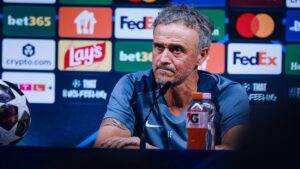
That summer workload has already shaped his August. Luis Enrique withdrew him at half-time of the 2-2 draw away at Rennes and then left him out of the squad altogether for the trip to Lille, insisting there was nothing more to it than freshness. “I am a big admirer of Ousmane Dembélé, I repeat that. He’s an essential player for us,” the coach said in his press conference, as reported by PSG Talk. “He is, was and will be an essential player for us.”
It is a fair summary of where he sits. Paris have sold forwards, bought forwards and rebuilt the front line around him more than once, and none of it has changed his standing. The squad churns; the No.10 stays.
Where he ranks in PSG history
He is not going to catch Edinson Cavani or Kylian Mbappé at the top of the club’s all-time scoring charts — those totals were built across far longer spells in Paris. What he has instead is the thing none of them managed in this shirt: a Ballon d’Or, with two European Cups to go beside it.
Fifteen years of PSG’s project were spent asking whether the club could turn superstars into a European trophy. Dembélé answered it the other way round, by becoming a superstar after he arrived.
Squad and player information is published by Paris Saint-Germain, with fixtures and results confirmed by Ligue 1 and European competition detail at UEFA.