Paris Saint-Germain have won the Champions League in back-to-back seasons and rebuilt their squad twice over in the process, but the loudest part of the club has not changed hands. The PSG ultras are the organised supporter groups who run the singing, the flags and the choreographed displays at the Parc des Princes — and their story is one of the strangest in European football, because for six years Paris deliberately shut them down.
Here is who they are, where they stand and how they came back.
Who are the Collectif Ultras Paris?
The Collectif Ultras Paris — almost always shortened to the CUP — is the umbrella group formed in 2016 that now organises ultra support at the Parc des Princes. It is not a fan club in the ticketing sense. It is a federation of smaller sections that agree to sing together, travel together and produce the tifos, the giant hand-held displays that turn one end of the stadium into a single picture before kick-off.
The CUP occupies the Virage Auteuil, the stand behind one goal, and it is the reason a Paris home game sounds the way it does. Capos with megaphones face the crowd rather than the pitch, songs run for the full 90 minutes rather than in bursts, and the group decides collectively what goes on the banners — including, on more than one occasion, criticism of the club’s own board and players.
Auteuil and Boulogne: the two ends explained
To understand the PSG ultras you have to understand that the Parc has two ends with two very different histories.
- Virage Boulogne — the Kop of Boulogne, or KoB, was the club’s original hardcore end from the 1970s. It built the first great atmospheres at the Parc and, by the 1980s and 1990s, had also acquired a reputation for violence and for far-right elements within it.
- Virage Auteuil — the opposite end grew from the early 1990s as a self-consciously different scene: Italian-style ultra culture, tifos, more visible support from the multi-ethnic Paris suburbs, and a rejection of what Boulogne had become.
For two decades those two ends were rivals inside their own stadium. Clashes between them were routine, and the hostility was not the pantomime kind that Le Classique against Marseille produces. It ran between two sets of Paris supporters who shared a club and nothing else.
The 2010 ban that emptied both ends
In February 2010, a PSG supporter died after clashes outside the ground. The response from the club, then under president Robin Leproux and still in pre-Qatari ownership, was radical: the so-called Plan Leproux dissolved the supporter associations, tore up the season-ticket arrangements that kept groups together, and scattered fans around the stadium by lottery, so that no bloc could form behind either goal.
It worked, in the narrow sense. The trouble largely stopped. It also drained the Parc des Princes of the noise it was famous for, and for six seasons — including the first years after Qatar Sports Investments bought the club in 2011 — one of the richest teams in Europe played in front of a strangely polite crowd. Visiting supporters routinely out-sang the home end.
How the PSG ultras came back
The thaw came slowly. Talks between the club and supporter representatives led to organised groups being allowed back into Auteuil, and in 2016 the Collectif Ultras Paris was created as the single structure the club would deal with. Tifos returned. So did permanent standing places, drums, megaphones and the sense that the Parc is a home ground rather than a corporate venue.
Boulogne’s ultras were not restored in the same way, which is why the modern Parc is lopsided: Auteuil is the engine, and the rest of the stadium follows it. If you have ever wondered why the “Ici c’est Paris” call-and-response works so cleanly across the ground, it is because one end starts it and everyone else answers.
What the ultras actually do on a matchday
Three things, mainly.
They stage the pre-match display. The big European nights are built around a tifo covering the whole of Auteuil, usually kept secret until the teams walk out. The club’s two Champions League final wins produced some of the largest ever attempted at the stadium — a fitting backdrop for a side that joined the short list of clubs to retain the European Cup.
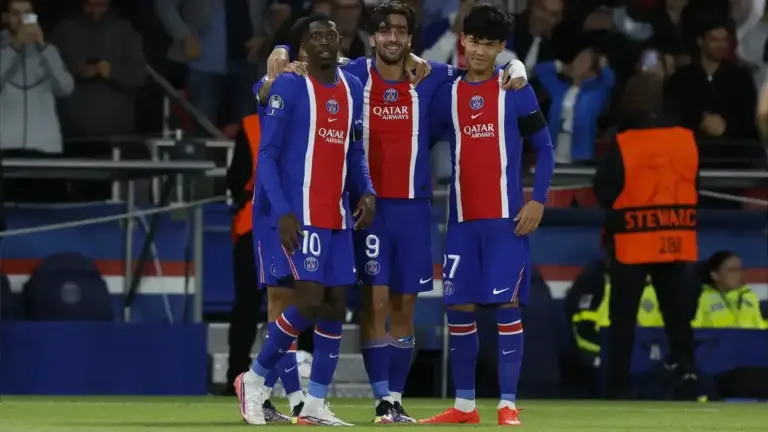
They set the tone for 90 minutes. Songs are led, not spontaneous. That is why the atmosphere can stay loud when Paris are four goals clear, as they were on their way to the 6-1 win over Slovan Bratislava that opened this season’s Champions League defence, with Ferran Torres scoring a hat-trick and Ousmane Dembélé twice. Both of those goalscorers have their own songs; the repertoire is as much a squad list as the team sheet is.
They protest. The CUP has used banners to attack transfer policy, ticket pricing and individual players it feels have not respected the shirt. That independence is the point of an ultra group, and it is also why the relationship with the boardroom has never been entirely comfortable, however many trophies arrive.
Are the ultras the same as PSG’s official supporters?
No. PSG run official supporter clubs and membership schemes worldwide, and the vast majority of people in the stadium on any given night are ordinary ticket holders. The ultras are a specific, self-organised minority who take on the work of making noise — funding and building the tifos, leading the songs, occupying the same steps for every game. They also travel in numbers to away fixtures, including short trips such as the derby with Paris FC.
Why it matters this season
Paris have started 2026/27 badly in Ligue 1 — winless after three games, seven points behind Monaco — and recovered their swagger in Europe. Seasons like this are exactly when the Auteuil end becomes a story in its own right: whistles for some players, songs for others, and banners that read like editorials. The trophies of the last two years bought Luis Enrique and his squad enormous credit with that stand. Nobody at the club will assume it is unlimited.
Match detail on the Champions League opener referenced above via Get French Football News and PSG Talk.