The PSG badge is one of the most recognisable crests in world football, and almost nobody outside France can explain all of it. The Eiffel Tower is obvious enough. The small orange flower underneath it is not. Neither is the reason a club founded in 1970 carries a reference to a French king born in 1638, or why two stars now sit above the whole thing.
Here is what every element of the Paris Saint-Germain crest means, where the design came from, and how it has changed.
What the PSG badge actually shows
The modern crest is a circle. Inside it, on a royal blue field, a red Eiffel Tower stands above a white fleur-de-lis. The word PARIS arcs across the top in large white capitals; SAINT-GERMAIN runs beneath the flower in much smaller type. Since the summer of 2026 there are also two gold stars above the circle.
Every one of those choices is a statement about where the club came from, because Paris Saint-Germain is a merger — and the badge is the compromise.
Why the Eiffel Tower is on the crest
The tower is the Paris half of the name, and it is there for the same reason the club exists at all.
PSG were created in 1970 to give the French capital a serious top-flight football club. Paris, unlike London, Madrid or Milan, had no dominant side and no continental pedigree; the new club was assembled specifically to fix that. A badge built around the most famous structure in the city was not subtle, and it was not meant to be. It said: this is the club of Paris.
That is the same instinct behind the terrace chant the club later adopted as a motto — our explainer on what "Ici c’est Paris" means covers how the territorial claim became the club’s entire identity.
The fleur-de-lis: the Saint-Germain half
The flower is the part most supporters skip past, and it is the more interesting half of the badge.
The fleur-de-lis is the heraldic emblem of Saint-Germain-en-Laye, the town in the western suburbs of Paris that provided the other side of the 1970 merger. Stade Saint-Germain brought the playing licence and the sporting infrastructure; Paris FC brought the money and the name recognition. The crest gives each of them a symbol, and the club kept both when the marriage collapsed two years later.
That collapse is a story in itself — the two halves separated in 1972 and became rivals, which is why the PSG vs Paris FC derby is the strangest fixture in French football.
The cradle and Louis XIV
Earlier versions of the badge carried something else beneath the tower: a cradle.
It was a reference to Louis XIV, the Sun King, who was born at the Château de Saint-Germain-en-Laye in 1638. The town’s single greatest claim on French history is that a king began there, and the early crest put it on the shirt — a royal cradle sitting under the Eiffel Tower, tying a brand-new football club to three centuries of national story.
The cradle has not survived every redesign, and the fleur-de-lis now carries the Saint-Germain reference on its own. But if you see an old PSG crest with an odd little basket shape at the bottom, that is what it is.
Red, blue and white — and the Hechter shirt
The colours are read the same way as the symbols. Red and blue are the colours of the arms of the city of Paris; white is traditionally explained as the Saint-Germain and royal element of the mix. Between them they give Les Parisiens a palette that belongs to nobody else in Ligue 1.
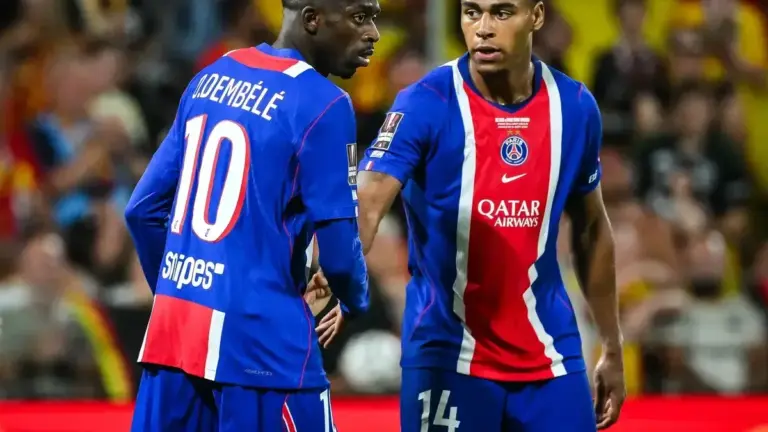
The shirt those colours produced is arguably more famous than the crest. Daniel Hechter, the fashion designer who served as club president during the 1970s, designed the home jersey that PSG still return to almost every season: blue, with a broad vertical red band down the centre of the chest, edged in white. It is known simply as the Hechter, and no other major European club has a signature shirt so closely associated with one designer’s name.
The 2013 redesign
The badge supporters recognise today dates from 2013, two years after Qatar Sports Investments bought the club and began rebuilding it as a global brand. The redesign was a simplification with a clear commercial logic: the Eiffel Tower was enlarged and pushed to the centre, PARIS became by far the dominant word on the crest, and SAINT-GERMAIN was reduced to small type underneath.
It was not universally popular in Saint-Germain-en-Laye, and you can see why. But the reasoning was straightforward — a crest sold in Tokyo, Los Angeles and Lagos works better if the first thing on it is a word the whole world already knows. For more on the ownership era that produced it, see our guide to who owns Paris Saint-Germain.
The two stars above the badge
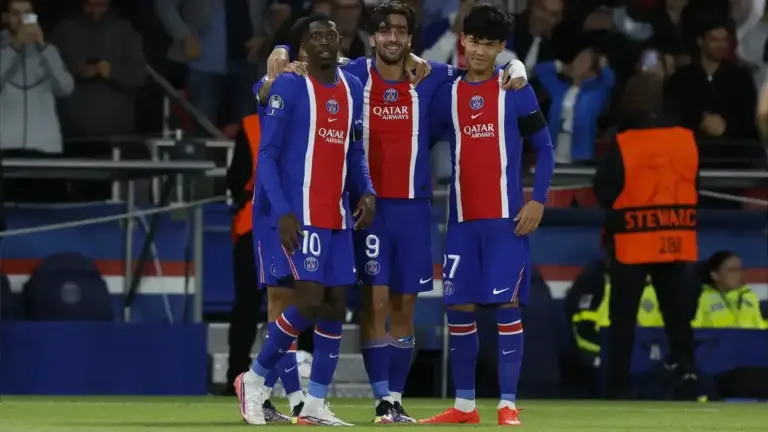
The newest addition is the simplest to explain. European stars mark continental titles, and Paris now have two: the Champions League won in 2024/25 and retained in 2025/26 under Luis Enrique, making them back-to-back holders.
The second star arrived on the 2026/27 crest, and it changed the character of the badge more than any redesign did. For four decades the PSG crest was a claim about a city. It is now also a record of what the club has won. Our breakdown of how many Champions Leagues PSG have won has the detail behind both of them.
PSG badge: the essentials
- Eiffel Tower: represents Paris — the club was founded in 1970 to give the capital a top-flight side.
- Fleur-de-lis: the heraldic emblem of Saint-Germain-en-Laye, the other half of the merger.
- Cradle: featured on earlier crests, referencing Louis XIV, born at Saint-Germain-en-Laye in 1638.
- Colours: red and blue from the arms of Paris, white for the Saint-Germain and royal strand.
- The Hechter shirt: the blue-with-central-red-band home kit designed by 1970s president Daniel Hechter.
- Current design: the 2013 redesign, which enlarged the tower and made PARIS the dominant word.
- Two stars: added for the back-to-back Champions League titles of 2024/25 and 2025/26.
Why the badge works
Plenty of clubs have crests that are essentially decoration. PSG’s is a map. It names a city and a suburb, a monument and a monarchy, and it does it in a circle small enough to fit on a sleeve.
The redesigns have shifted the balance — Paris has grown, Saint-Germain has shrunk, and the cradle has gone — but the two founding halves are still both on the shirt more than fifty years after they stopped being one club. That is a rare thing in modern football, where rebrands usually flatten history rather than preserve it. Whatever the Parc des Princes end up looking like after the redevelopment debate is settled, the flower is not going anywhere.
For the ground itself, read our Parc des Princes stadium guide, and for the current group wearing the crest, our PSG squad guide for 2026/27.
Club identity, crest and kit information is published by Paris Saint-Germain. Competition records are held by Ligue 1 and UEFA.