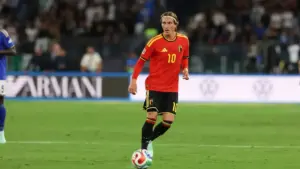
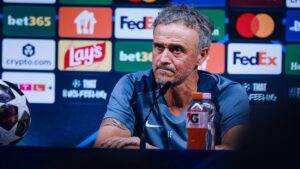
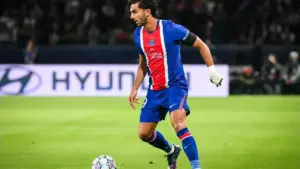
Luis Enrique has won back-to-back Champions Leagues with a side built on control, but somebody still has to score. Working out who makes up the PSG attack in 2026/27 means working through six forwards: Ousmane Dembélé, Khvicha Kvaratskhelia, Ferran Torres, Désiré Doué, Mika Godts and Quentin Ndjantou. Between them they include a reigning Ballon d’Or winner, a €48.5m arrival from Barcelona, two academy forwards and precisely no orthodox centre-forward.
That last point is the whole story of this department. The 2026 summer stripped four attacking names out of the building and replaced them with two, and the shape of what is left tells you a great deal about how Luis Enrique wants Paris to play. Here is the full picture, front to back.
Ousmane Dembélé (No.10) — the one everything runs through
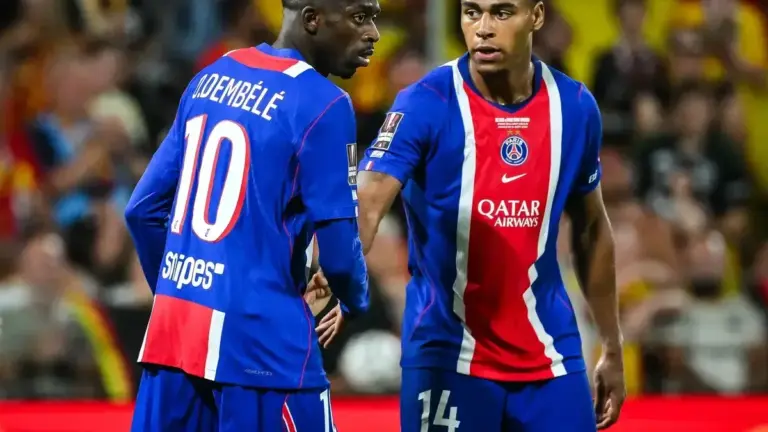
Dembélé is the reigning Ballon d’Or winner and the senior figure in the forward line, one of Marquinhos’ vice-captains alongside Achraf Hakimi and Vitinha. He wears the No.10, and he is the closest thing this squad has to a guaranteed name on the team sheet.
What makes him awkward to categorise is also what makes him useful. Dembélé is nominally a winger who has spent two European campaigns operating through the middle, dropping into the space a defensive midfielder would rather not vacate and running at centre-halves from angles they are not set up for. He is a forward who defends from the front and a No.10 who plays like a No.9 when it suits. Our full profile of Dembélé covers how he got from Barcelona to the centre of all this.
Khvicha Kvaratskhelia (No.7) — the left-sided threat
Kvaratskhelia has the No.7 and the most clearly defined job in the group: take the ball on the left touchline, beat somebody, and make something happen. The Georgian is the player Paris supporters look for when a game has gone flat, and he is one of nine Parisians on this year’s Ballon d’Or nominee list — a record haul for a single club in consecutive editions.
He is also the department’s contract question. Paris have been reported to have tabled a new deal for him, which is the kind of story that only attaches to players a club has no intention of losing. Read our profile of Kvaratskhelia for the longer version.
Ferran Torres (No.9) — the summer’s big attacking bet
Torres is the newest senior forward and the most scrutinised. Paris paid Barcelona a reported €48.5m for him in the summer of 2026 and handed him the No.9 shirt, which in most squads would settle the question of who leads the line. Here it settles rather less.
The Spaniard can play centrally or off the right, and the flexibility is presumably the appeal for a manager who rotates his front three constantly. He also arrives with something to prove: he was not a guaranteed starter in Catalonia, and he is replacing goals that left the club in bulk. He appears on the Ballon d’Or list credited to “Barcelona/Paris Saint-Germain”, his qualifying season having been spent in Spain. More on why Paris went for Ferran Torres.
Désiré Doué (No.14) — the one with a point to make
Doué wears No.14 and is, on age alone, the forward with the most road ahead of him. He is a two-footed wide player comfortable on either flank, and he has been trusted in the biggest matches this squad has played.
His 2026 has a sting in it, though. Doué was left off the 30-man Ballon d’Or shortlist despite being a regular for the European champions — a snub we covered when the list landed, and one that will not have gone unnoticed in the dressing room. Our profile of Doué sets out the case for him.
Mika Godts (No.22) and Quentin Ndjantou (No.47) — the young ones
Godts is the forgotten piece of the summer window. Paris paid Ajax somewhere in the region of €45m for him — a substantial fee for a young winger — and gave him the No.22. He is a wide forward arriving into a squad that already has Kvaratskhelia, Doué and Torres competing for the same shirts, which makes him both an investment and a patience exercise. Here is the full story on Godts.
Ndjantou, No.47, is the academy forward with the least first-team mileage of the six. He has been named in senior squads, including for the Champions League, which at a club with this much money in the attacking department is itself a statement about how he is rated internally. The sensible expectation is minutes rather than starts.
The forwards who left, and the No.9 question
Four attacking players departed in 2026, and the money involved explains why the department looks thinner than it feels. Bradley Barcola left for Liverpool on deadline day in a deal reported to be worth up to €140m. Gonçalo Ramos joined AC Milan for €74m, Randal Kolo Muani moved permanently to Juventus for €38m, and academy forward Ibrahim Mbaye was sold to Aston Villa for €55m. The No.29 and No.49 shirts they vacated remain unassigned, as our guide to the 2026/27 squad numbers sets out.
Ramos and Kolo Muani were the two players in the squad who actually played as centre-forwards. Both are gone, and neither was replaced with a like-for-like No.9 — Torres is a forward who can play centrally rather than a target man, and Godts is a winger. That is a deliberate choice rather than an oversight. Luis Enrique’s Paris attack a defence with movement and overloads instead of a fixed reference point, which is a fair summary of the whole formation.
How the PSG attack shapes up
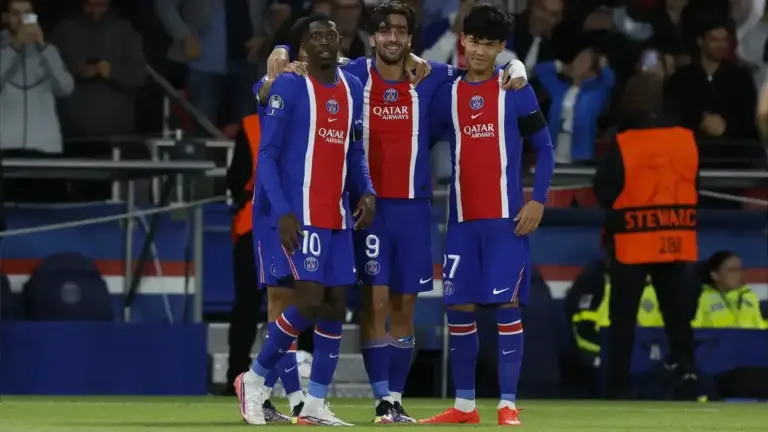
Six forwards for three shirts, with Maghnes Akliouche — officially one of the seven names in the PSG midfield — comfortable enough in the final third to make it seven contenders on a given week. Dembélé and Kvaratskhelia are the fixed points. Torres, Doué and Akliouche compete for what is left, and Godts and Ndjantou are being developed rather than relied upon.
The department’s problem in 2026/27 is not talent. It is that Paris are winless in Ligue 1 after three matches — 2-2 at Rennes, 2-2 at Lille and a 2-1 defeat by Monaco — with Monaco seven points clear of them at the top, per Get French Football News, and Luis Enrique conceding that “if we’re just talking about results, it’s been a disastrous start to the season”. Marquinhos, for his part, has said he hopes the Ballon d’Or stays in Paris — “we have very good players,” he told a press conference, declining to pick one.
He is right that they are very good players. Whether they are the right combination of them, with no centre-forward and €300m of attacking talent sold, is the question this season will answer. If you want the other end of the pitch, we have explained the PSG centre-backs too.