Read enough Paris Saint-Germain coverage and you will keep meeting the same four words: “in the mixed zone”. A player has said something about the title race, about a manager, about his own form — and the line that carries it is almost always that he said it there. English-language readers get the quote and almost never get the room. So here is the room.
What is a mixed zone?
A mixed zone is the stretch of corridor between a dressing room and the team bus, and it is the one place in a stadium where footballers and journalists are deliberately put in each other’s path. Accredited reporters stand behind barriers on one side. Players walk down the other. Nobody is seated, nobody has a microphone stand, nobody has a running order. It is a walk, and the walk is the interview.
The arrangement is not informal goodwill. At club and European level the route is a condition of staging the match: the competition organiser requires a designated media area on the players’ exit path, and clubs build it into the matchday plan alongside everything else a fixture demands of them. That is why you will find one at the Parc des Princes and at every ground the PSG squad visits, whatever the competition.
Players choose whether to stop
This is the part that gets lost in translation, and it is the most important thing about the format: the area is compulsory for the club, not for the individual. A player has to pass through it. He does not have to say a word while he does. He can nod, keep walking and be on the coach in ninety seconds.
Which means every quote you have ever read from one exists because somebody decided, minutes after a final whistle, that he wanted to speak. That decision is itself information. A captain who stops after a bad night is making a point about responsibility; Marquinhos has built a decade of credit at PSG doing exactly that. A forward who stops after a hat-trick is doing something else entirely. And a squad that walks past the barriers in silence for a month is telling you something too.
Mixed zone, flash interview, press conference: three different rooms
English coverage tends to flatten all post-match talking into one category. In practice a European night produces at least three distinct settings, and they are not interchangeable.
- The flash interview. Pitchside or just off it, seconds after the whistle, conducted by the broadcaster holding the rights to that match. Shortest, rawest, most adrenal — and the reason a player sometimes says something on his way down the tunnel that his club would rather he had slept on.
- The mixed zone. Later, on the way out, open to the wider accredited press rather than one rights-holder. Longer answers, more follow-ups, more chance of a real exchange — and the source of most of the reflective, self-critical lines that end up as headlines.
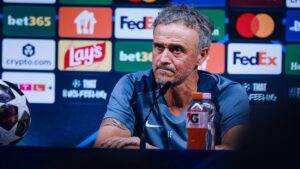
- The press conference. A room, a table, a moderator. Usually the manager — Luis Enrique, in PSG’s case — sometimes one nominated player. The most controlled of the three, and the one where a question can be declined outright.
When a report tells you which of those a quote came from, it is telling you how much weight to put on it. A line delivered standing up, coat on, bus waiting, is not the same as a line delivered to a room full of cameras with a club press officer sitting alongside.
Why the quotes read the way they do
Three things shape the texture of this material, and once you know them the quotes stop looking strange.
They are spoken, not written. Nobody standing in a corridor produces polished sentences. Answers loop back on themselves, trail off, get corrected mid-thought. What reaches you in English has almost always been tidied.
They are translated twice. A Georgian winger answering in English, a Portuguese midfielder answering in French, a Spanish forward answering in Spanish — all of it filtered through a French outlet and then through an English one. Nuance leaks at every stage. When Khvicha Kvaratskhelia answers a question about individual awards, or Ousmane Dembele about the state of the team, the version you read is at least the third rendering of what was actually said.
They are competitive. Dozens of reporters, one walking subject, a few minutes. The incentive is to get the answer nobody else got, which is why the sharpest questions — and the sharpest reactions to them — tend to arrive here rather than in the formal room.
Where the French press fits
Most of this material reaches English-language PSG coverage second-hand: gathered in French, by French outlets, translated afterwards. L’Équipe is the most frequently cited of them, but it is one of several, and the chain matters. A line can be reported accurately, translated loosely, and then re-reported as if the looser version were the original.
The governance sits with the bodies we have covered separately — the LFP for the domestic competition, the FFF for the game nationally, and UEFA for European nights, including the Champions League league phase PSG are contesting again as holders.
How ReadPSG handles it
Our rule is the one we apply to every French-press story: attribute it, never assert it. If a quote reached us through a corridor and a translation, we say who gathered it and where. We do not present a tidied English rendering as a verbatim transcript, and we do not build a fact on top of a quote that has travelled through two languages to get to us.
It is also why you will see this material framed as opinion and mood rather than evidence. A player saying the season has started badly is a player’s reading of it, offered on his way out of a stadium. It is worth reporting. It is not a measurement, any more than a Ballon d’Or ranking is.
What is not confirmed
We are not stating the specific regulation that mandates the area, the minimum period organisers require it to stay open, the physical layout at any individual stadium, or which broadcasters hold first-access rights to PSG matches in any given market. Those details vary by competition and by season, and none of them are established here. Where this piece describes practice, it is describing common practice, not quoting a rule.
None of which makes these quotes less useful. It makes them a specific kind of useful — unguarded, voluntary, spoken at the worst possible moment for composure. That is exactly why they keep making headlines, and exactly why they should be read for what they are. More on how French football reports itself in our guide to L’Équipe and its influence, and on the wider picture at UEFA and Get French Football News.