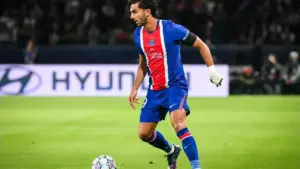
Every September the same argument arrives on schedule, and every September a large number of people take part in it without ever being told how the thing actually works. This is the Ballon d’Or explained properly: what the award is, who hands it out, how the shortlist is assembled, who fills in the ballot papers, and why Paris Saint-Germain have spent two years at the centre of the whole conversation.
The Ballon d’Or explained in one sentence
The Ballon d’Or is an individual prize for the best footballer of the preceding season, organised by the French magazine France Football and handed out at a ceremony in Paris. It is not awarded by a club, a league or a governing body. It is a magazine’s award, voted on by journalists, and that unusual ownership explains a great deal about how it behaves — including why its editor-in-chief can be asked to publicly justify a selection, and does.
The 2026 edition follows the familiar shape: a 30-man shortlist published in September, an argument that runs for six weeks, and the winner revealed in Paris on 26 October.
How the 30-man shortlist is drawn up
Before anybody votes for a winner, somebody has to decide who is eligible to be voted for. That is the shortlist, and it is the stage where most of the genuine controversy lives, because thirty is a brutally small number for a season played across every major league and a summer tournament on top.
How tight it can get was laid bare this year by France Football‘s own staff. After Désiré Doué was left out of the 2026 list, journalist Olivier Bossard said on L’Équipe de Greg that the PSG forward had finished “31st or 32nd on the list”, per Get French Football News. One place outside. Editor-in-chief Vincent Garcia went further and published an explanation of the omission in L’Équipe, pointing to Doué sharing “the limelight and the statistics” with a team-mate who played the same role.
Two things follow from that. First, there is a ranked order behind the shortlist, not a vague vibe — a player can be told he was 31st. Second, the people compiling it are willing to explain themselves afterwards, which is not true of most awards in the sport. Our full account of how Doué missed the cut goes through both explanations in detail.
Who votes, and what they weigh
The winner is chosen by an electorate of journalists rather than by players, managers or supporters. That single design choice shapes the result more than any written criterion, because journalists vote on narrative as much as on output: the story of a season tends to beat the spreadsheet of one.
The clearest illustration this year is Khvicha Kvaratskhelia. His club form is not in question. What complicates his candidacy is that Georgia were not at the World Cup, and a portion of the electorate treats a summer international tournament as the tie-breaker between otherwise comparable seasons. Toni Kroos and Michel Platini have both publicly said that should not count against him. The player himself, asked directly, declined to campaign: “I think it doesn’t depend on me, it depends on the people who decide,” he said, as reported by PSG Talk. That is the honest summary of the process — a small, unelected group of writers weighing one kind of achievement against another, with no formula anyone outside the room can audit.
Why PSG own this year’s list
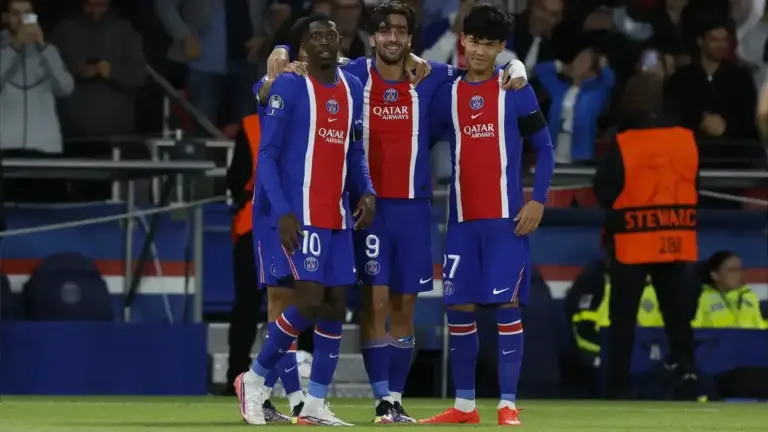
Paris Saint-Germain have nine players on the 2026 shortlist. Per Get French Football News, no club in the award’s history had previously placed nine nominees in back-to-back editions — Real Madrid have managed nine in a single year, but never twice running. The next best-represented club on this year’s list is Bayern Munich, with four.
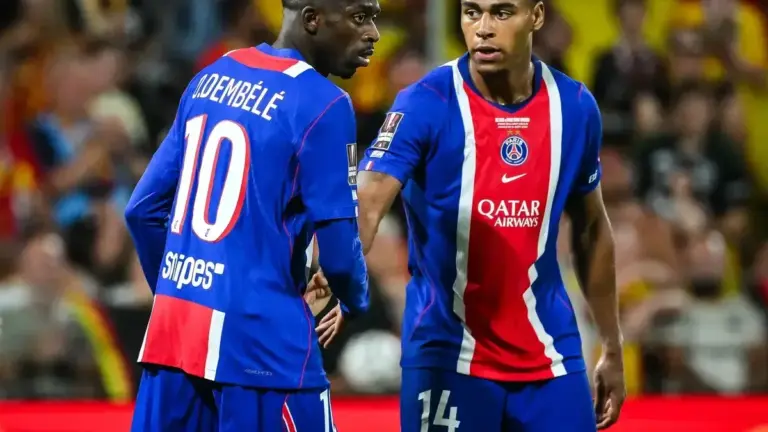
The spread is the interesting part: two full-backs, three midfielders, two centre-halves and two forwards. Achraf Hakimi, Nuno Mendes, Vitinha, João Neves, Fabián Ruiz, Khvicha Kvaratskhelia, Willian Pacho, captain Marquinhos and reigning winner Ousmane Dembélé all made it. For a squad that spent a decade being accused of being a collection of individuals, a nine-man nomination list built on defenders and midfielders is a fairly pointed rebuttal. The full breakdown is in our piece on PSG’s record nine nominees.
Ferran Torres also appears, credited as “Barcelona/Paris Saint-Germain” — the qualifying season was spent in Catalonia, which is why the count of current Parisians stops at nine.
How many PSG players have actually won it?
Two. Lionel Messi took the 2021 award months after arriving in Paris, and Ousmane Dembélé won the 2025 edition off the back of the club’s first Champions League — the first Ballon d’Or won for what a player did in a PSG shirt rather than merely while employed by the club. The longer version, including the famous near-miss, is in our guide to every PSG Ballon d’Or winner.
The gap between nine nominees and two winners is the whole tension of the award in one statistic. Nominations measure a squad. The Ballon d’Or measures a story.
What is not confirmed here
Deliberately absent from this explainer: the exact size and national composition of the voting jury, the number of players each voter ranks, how those rankings are converted into points, and the formal criteria France Football publishes for judging candidates. Those details are not verified in our records and are not asserted above. The same applies to the other trophies handed out on the night, to the women’s award, and to any prediction of who wins on 26 October — Dembélé’s status here is as reigning champion, not as favourite. Where a claim above comes from a French outlet, it is attributed rather than stated as established fact.