Paris Saint-Germain left the Stade Orange Vélodrome with all three points, but this Le Classique win was earned in three chaotic minutes rather than over ninety. Marseille equalised, then conceded again almost immediately as the visiting captain settled the contest. It happened in a flash. For a club used to winning games comfortably, this was a different kind of test.
Newer supporters keen on understanding Parisian football heritage and terms will find no better lesson in what Le Classique actually means than the closing half hour at the Vélodrome. Few fixtures in French football carry the same weight. Few grounds make visiting sides feel it as sharply as Marseille’s home end.
Resilience Under Fire at the Stade Orange Vélodrome
The Vélodrome has never been a comfortable away trip, and Saturday night was no exception. Marseille’s supporters created a wall of noise from kick off, the kind of setting that has undone visiting sides for decades. PSG’s own travelling contingent matched it note for note, part of the passionate atmosphere created by supporters that follows this club into hostile territory.
Luis Enrique’s side had to absorb spells of real pressure before finding a foothold. Marseille pushed hard in the second half. For a period, it looked as though home advantage might tip the balance. Instead, PSG found the composure to survive the loudest moments and strike when it mattered.
That composure has become something of a hallmark under Luis Enrique. His side rarely panics when a game turns scrappy, and Saturday’s win offered fresh proof. Rather than retreat after Marseille drew level, PSG responded within minutes.
How Three Explosive Minutes Unlocked Le Classique
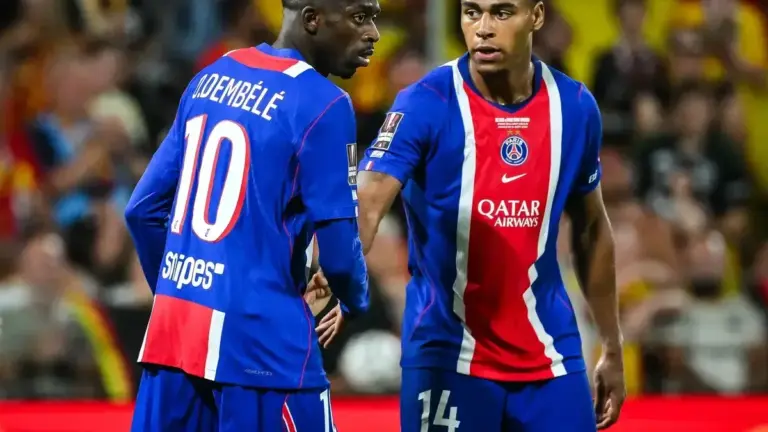
The breakthrough came in the 66th minute. Ferran Torres finished off an assist from Désiré Doué to put PSG ahead, a goal built on the kind of quick combination play that has defined much of their season. Doué’s contribution was decisive, threading the pass that gave Torres his chance in behind the Marseille defence.
Marseille responded quickly. Angel Gomes levelled the score in the 72nd minute, sending the home crowd into a frenzy and briefly shifting the momentum of the entire match. For three minutes, Le Classique hung in the balance, with both sides sensing an opening.
Then, in the 75th minute, just three minutes after Gomes’ equaliser, Marquinhos rose to head PSG back in front. The speed of the response was the story. Rather than allow Marseille’s goal to settle into the crowd’s momentum, PSG snatched it straight back.
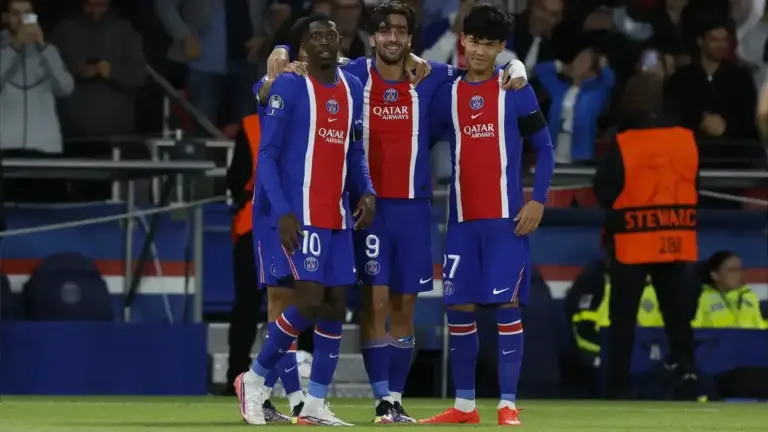
Three goals in nine second half minutes turned a tense, cagey Classique into one of the most dramatic passages of the season so far. It was the kind of sequence that decides these fixtures. PSG were the side who came out on top of it.
Dissecting Marquinhos’ Winning Impact and Marseille’s Red Card
Marquinhos has captained this PSG side through some of its biggest nights, and his winning header fit that pattern. Scoring so soon after conceding is rarely about instinct alone; it takes a settled mind to find a header at the back post in a stadium desperate for the opposite result. As captain, his response set the tone for how the rest of the team handled the closing stages.
His finish also reflected PSG’s willingness to keep pushing bodies forward at set pieces even in the tightest moments of a Classique. Marseille had just found a way back into the game. Sitting deep and protecting a point would have been understandable. Instead, PSG’s captain answered immediately.
Marseille’s night worsened further when Timothy Weah was sent off late on. The dismissal left the hosts to see out the closing stages a man light, compounding a difficult finish to the match. Playing with ten men against a PSG side already ahead made any route back to a point far harder.
Goal’s match assessment of Le Classique captured how quickly the contest swung once the goals started, with the closing period shaping the outcome as much as anything that came before it. The scoring burst, followed by a red card against ten already stretched Marseille players, left little time for a way back into the game.
What Victory in Marseille Means for Luis Enrique’s Season
Winning Le Classique away from home carries weight beyond three points. It is a statement fixture, one that shapes how a season is remembered regardless of what happens in the months that follow. For Luis Enrique, this result adds evidence to a growing case that his squad can handle adversity in the biggest matches, not just dominate weaker opposition.
The manner of the win matters as much as the result itself. PSG did not control every phase of the match, and they were pegged back by Marseille’s response. What they showed instead was the ability to reset quickly under real pressure, in front of a hostile crowd, in a fixture that punishes hesitation.
Marquinhos’ role in that response says something about the squad’s leadership beyond the captain’s armband. A team that can find a winning goal within three minutes of conceding, away at the Vélodrome, is a team with genuine belief in itself. That belief will be tested again as the season moves on. This result gives Luis Enrique further proof his approach is working when it counts most.
For PSG supporters, the scoreline will matter most, but the way the win was built tells a fuller story. Three goals in nine minutes. A captain’s response under pressure. A red card Marseille could not recover from. Le Classique often turns on moments like these, and on this occasion, PSG made sure they were the side left celebrating.