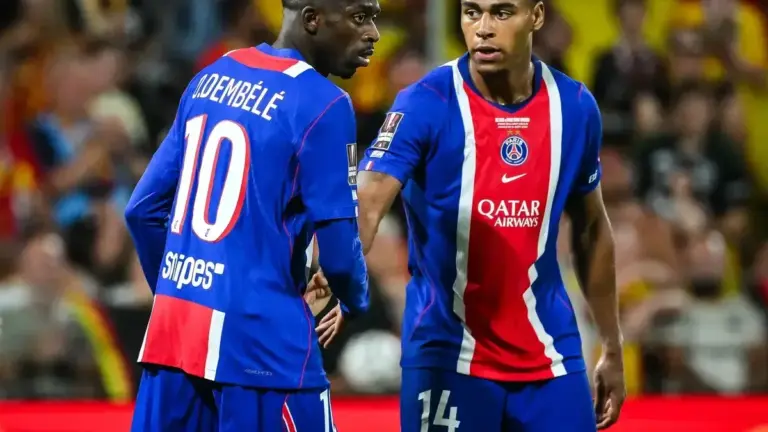
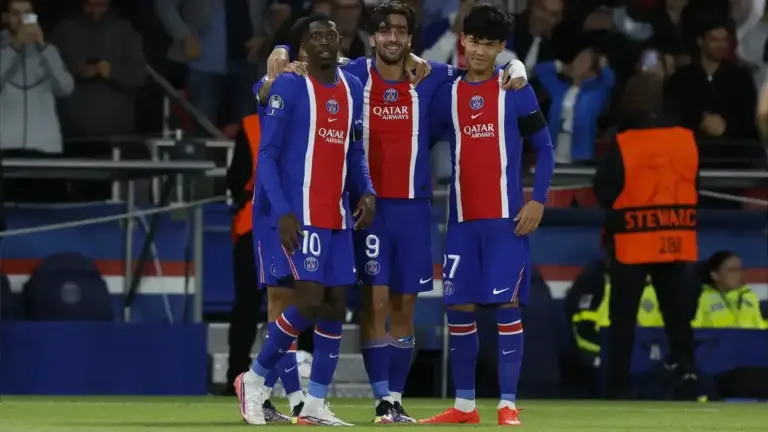
Almost every big club has a home shirt. Paris Saint-Germain have something rarer — a home shirt with a designer’s name attached to it. The PSG Hechter shirt is the blue jersey with the broad red band running straight down the middle of the chest, edged in white on either side, and it has been the club’s visual signature for most of its existence.
Here is the explainer: who Daniel Hechter was, what the design actually is, why Paris wear those three colours, and why a kit first drawn in the 1970s is still the shirt the club returns to almost every season.
Who was Daniel Hechter?
Daniel Hechter is a French fashion designer who served as president of Paris Saint-Germain during the 1970s — the club’s first decade, after its founding in 1970 finally gave the French capital a top-flight side of its own.
That combination is the whole story. Most clubs of that era had their kits chosen by committee, or inherited them from whichever amateur side they had grown out of. Paris had a working couturier in the president’s chair at exactly the moment a brand-new club needed to decide what it looked like. He designed the home jersey himself, and the result has outlasted his presidency by half a century.
What the PSG Hechter shirt actually looks like
The design is simple enough to describe in one sentence, which is part of why it works: a blue shirt, with a broad vertical red band down the centre of the chest, edged in white on both sides.
No hoops, no sash, no pattern. One stripe, running top to bottom, splitting the front of the shirt in half. Supporters know it simply as the Hechter, and no other major European club has a signature kit so closely associated with one designer’s name. Manchester United do not wear “the Busby”. Paris wear the Hechter.
Why red, blue and white?
The colours are not a fashion choice. They are a map, in exactly the way the crest is.
Red and blue are the colours of the arms of the city of Paris. White is traditionally read as the Saint-Germain and royal element of the mix — the other half of the club’s name, and of its history. Between them they give Les Parisiens a palette that belongs to nobody else in Ligue 1, and it runs through the badge as well as the shirt. Our guide to the meaning of the PSG badge has the full breakdown of the Eiffel Tower, the fleur-de-lis, and the cradle that used to sit beneath them.
It also explains one of the club’s oldest nicknames. Rouge et Bleu — red and blue — is used on official club media and in supporter writing as a warmer stand-in for three initials, and it comes straight off the front of the Hechter. We have covered that and the rest in our piece on PSG’s nicknames.
Why the design survived
Kit design in modern football is a churn industry. Clubs release three or four shirts a season, chase a different retro reference every summer, and quietly retire the ideas that did not sell. Against that, the Hechter has been remarkably immovable.
The reason is that it is a template rather than a single shirt. The red band can be widened or narrowed, the white edging thickened or thinned to a pinstripe, the blue shifted darker or lighter, the collar changed completely — and it is still recognisably the Hechter. That gives a kit manufacturer room to sell something new every year without throwing away the club’s identity, which is the problem most heritage designs cannot solve.
Away and third kits are where Paris experiment, and they can change character entirely from one season to the next. The home shirt is the constant. Whenever the club has strayed from the central band, supporters have noticed — and it has never been long before the stripe came back.
The Hechter in the modern era
What has changed around the shirt is everything else. Under Qatar Sports Investments, PSG became a global apparel brand as much as a football club, and a 1970s design found itself on a Jordan Brand jersey selling in cities that had never watched a Ligue 1 match. The badge was simplified in 2013 to travel better, with the Eiffel Tower enlarged and PARIS made the dominant word on the crest.
The most recent change sits above the badge rather than on the chest. Two stars now appear on the shirt, marking the back-to-back Champions League titles of 2024/25 and 2025/26 — the detail is in our explainer on the PSG two-star logo. More than fifty years after a fashion designer drew a red band on a blue jersey, that jersey is the one the reigning champions of Europe defend their title in.
PSG Hechter shirt: the essentials
- Designer: Daniel Hechter, French fashion designer and PSG president during the 1970s.
- The design: blue shirt, broad vertical red band down the centre of the chest, edged in white.
- The colours: red and blue from the arms of the city of Paris; white for the Saint-Germain and royal strand.
- The name: known simply as “the Hechter”; the same palette feeds the club nickname Rouge et Bleu.
- Why it lasts: a template rather than a fixed shirt — band width, edging and shade can all change and it still reads as the Hechter.
- Today: worn with the 2013 crest and, in 2026/27, two stars for back-to-back Champions League titles.
Why it matters
Paris Saint-Germain have spent fifteen years being told they are a club without history, a project rather than an institution. It is a lazy line at the best of times, and the shirt is the quickest rebuttal available. The players in the 2026/27 squad walk out at the Parc des Princes in a design that predates almost all of them by decades, chosen by a president who ran the club when it was nobody’s superpower.
The money is new. The stripe is not. Current kit information is published by Paris Saint-Germain.