PSG nicknames come at you from every direction — Les Parisiens on French television, Rouge et Bleu on the club’s own channels, the Titis in the academy, the Parc on matchday. Follow Paris Saint-Germain for a season and you will hear all of them, often in the same broadcast, without anyone stopping to explain which is which.
So here is the full list: what each nickname means, where it came from, and how Parisians actually use it.
Les Parisiens
The simplest one, and the one you will hear most. Les Parisiens means, straightforwardly, “the Parisians” — the standard French shorthand for the club in commentary, in print and in conversation. English coverage borrows it wholesale, which is why an English-language site like this one will write “Les Parisiens” in a sentence that is otherwise entirely in English.
It is a geographical nickname rather than a poetic one, and it carries a little more weight than it looks. Paris went a very long time without a football club of real national significance, and a name that simply claims the capital is a statement in itself. The club leans on it hard in its modern branding, where the word Paris increasingly does the work that the initials PSG used to.
Rouge et Bleu
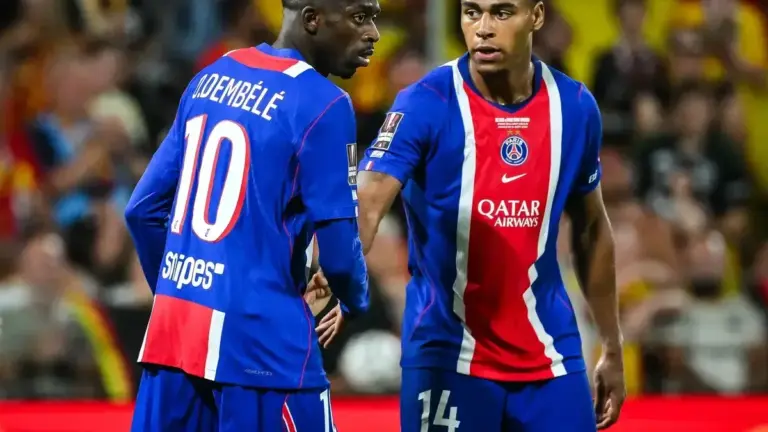
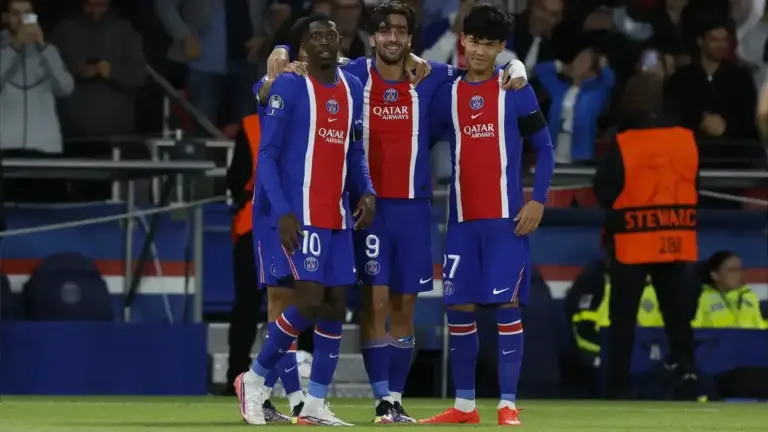
The club’s colour nickname: Rouge et Bleu, red and blue. You will see it on official club media, on merchandise and in supporter writing, usually as a stand-in for “PSG” when a writer wants something warmer than three letters.
Red and blue are the colours of the city of Paris itself, and they sit either side of a white stripe on the classic home shirt — the Hechter design that has been the club’s visual signature for most of its existence. The same palette runs through the crest, alongside the Eiffel Tower and the fleur-de-lys. If you want the detail on that, we have broken it down in our guide to the meaning of the PSG badge.
Paris SG, PSG, Paris
Three versions of the same name, used in different places. Paris SG is the form you will see in French league tables and on scoreboards, where space is short. PSG is the global shorthand, the one that ended up on a Jordan Brand shirt and travelled the world with it.
And then there is Paris on its own, which is the direction the club has been pushing for years now — the single word on the front of recent kits, the anchor of its commercial identity. It is a deliberate choice: a club that wants to be read as the team of a global city rather than a suburban merger.
That merger, incidentally, is why the full name is what it is. Paris Saint-Germain was formed in 1970 by joining a Paris club with Stade Saint-Germain, based in Saint-Germain-en-Laye west of the city — and the older half of that story is also the reason the capital’s derby with Paris FC carries the edge it does.
Les Titis Parisiens
The best of the PSG nicknames, and the one that needs the most explaining. A titi parisien is a piece of old Parisian slang for a street kid of the capital: quick, cheeky, unmistakably of the city. Think of the urchin archetype in French literature and film, and you have it.
At PSG the phrase belongs to the academy. The Titis are the homegrown players — the ones who came up through the club’s youth setup rather than arriving on a transfer fee. It is used with real affection, and a little defiance, at a club whose reputation abroad is built on expensive imports.
The current first-team squad has several. Warren Zaire-Emery, who wears 33, is the emblematic modern example, and Senny Mayulu (24) is the next of them to establish himself. You can read our profiles of Zaire-Emery and Mayulu, or the full 2026/27 first-team list, to see how the academy sits inside a squad that also spent heavily this summer on Maghnes Akliouche, Ferran Torres and Mika Godts.
The Parc
Not a nickname for the club but for its home, and used constantly. Le Parc is the Parc des Princes in the 16th arrondissement, PSG’s stadium since 1974 and the building the club has spent years trying to buy or replace. “At the Parc” is how everyone, including this site, refers to a home fixture.
Its two ends have names of their own that matter as much as the club’s do. The Auteuil and Boulogne stands are where the supporters’ groups sit, and the culture in them is a subject in itself — we have covered it in our explainer on the Collectif Ultras Paris.
What about “Ici c’est Paris”?
This one gets called a nickname and it is not. Ici c’est Paris — “this is Paris” — is the club’s motto and its defining chant, painted around the Parc and roared before kick-off. It names an attitude rather than a team. The full story of where it came from is in our piece on the meaning of Ici c’est Paris.
Which of the PSG nicknames should you use?
Use whichever fits. In English coverage, Les Parisiens and Paris are the two that read naturally in a match report; Rouge et Bleu works when you are writing about the club as an institution; the Titis should be saved for the academy players it actually belongs to, because using it about a €50m signing is the sort of thing that gets you corrected quickly in Auteuil.
All of them, in the end, are versions of the same claim — that this club is the football team of Paris. For a European champion now defending the trophy for a second time, and doing it under Luis Enrique with a squad that is younger and more homegrown than the one that came before, that claim is easier to make than it has ever been. The club’s own site at en.psg.fr is the place to start if you want the dates behind the names.