If you follow Paris Saint-Germain closely enough, sooner or later a French colleague will mention the Coupe Gambardella as though everybody already knows what it is. For an English-speaking audience it is one of those pieces of furniture in French football that never quite gets explained — so here it is, in plain terms, along with why it keeps coming up whenever the conversation turns to the Titis Parisiens.
What is the Coupe Gambardella?
The Coupe Gambardella is France’s national knockout cup for youth teams. It is organised by the French Football Federation rather than by the professional league, and it sits at the top of the country’s youth calendar in roughly the same way the Coupe de France sits at the top of the senior one: a single-elimination bracket, open across the pyramid, ending in one showpiece final.
It was created in 1954 and is named after Emmanuel Gambardella, a former president of the French Football Federation. It is contested at the under-19 age bracket, which is why you will see it described in French coverage as the coupe nationale des U19. That is the competition in which a professional club’s academy side and a small amateur club’s best age group can end up in the same draw — and occasionally in the same match.
How the competition works
The structure is the part that confuses people, because the Gambardella is really two competitions bolted together.
- A regional qualifying phase. Clubs enter through their local federation districts and leagues, playing knockout rounds against opposition from their own part of France. The overwhelming majority of entrants never leave this phase.
- A national phase. The survivors go into a national bracket, where the academy sides of professional clubs — Paris Saint-Germain’s among them — enter and the draw stops being regional. From there it is straight knockout football: one match, one winner, no second leg and no away-goals arithmetic to fall back on.
The rounds narrow in the usual cup shape until a single final remains, and that final has traditionally been staged as the curtain-raiser to the Coupe de France final — same stadium, same day, a youth-team showpiece played in front of a crowd that has turned up for the senior game. The exact venue, date and entry arrangements are set by the federation each season, so treat any specific year’s details as something to check rather than assume.
Why it matters to PSG
Paris Saint-Germain’s academy is not short of competitive football, but almost all of it is league football: weekly, developmental, played in front of a few hundred people on a training-ground pitch. The Gambardella is the one thing on that calendar that behaves like a proper cup. It is a draw. It is a one-off. It can end a season in ninety minutes, and it puts a teenager in a stadium with a scoreboard and an audience for the first time in his life.
That has a value the league table does not capture. Coaches at every French academy will tell you that cup knockouts are where you find out which players shrink and which ones grow, and the club’s recruitment staff watch the later rounds accordingly. When a young Parisian is described in the French press as having “come through” at the club, the Gambardella run is very often part of what is being referred to — along with the reserve side and, eventually, a bench seat at the Parc des Princes.
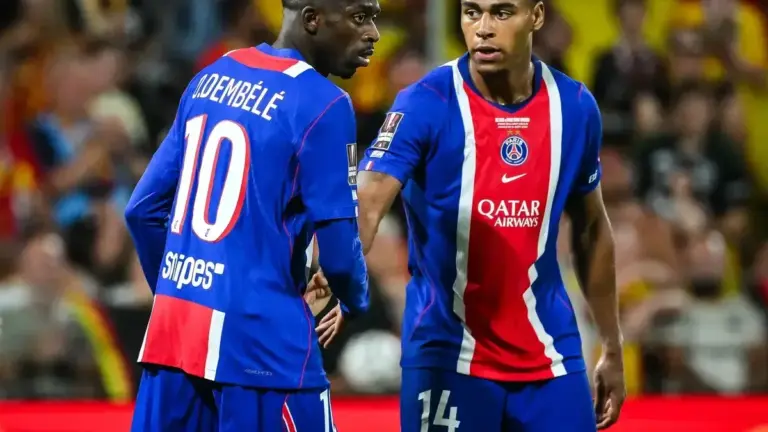
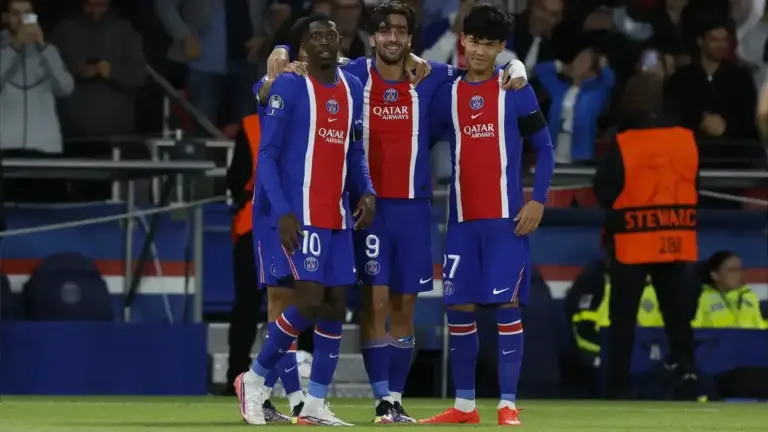
The pathway itself is well trodden in Paris. Warren Zaïre-Emery and Senny Mayulu are both academy products now carrying squad numbers in Luis Enrique‘s first-team group, and every one of those graduations began several years earlier in the age-group football the Gambardella sits on top of.
What the Gambardella is not
Three quick clarifications, because all three get muddled in English-language coverage.
It is not a European competition. There is a separate continental youth tournament — the UEFA Youth League — and it has nothing to do with the Gambardella. One is a French domestic cup run by the French federation; the other is a European competition run by UEFA. A club can be involved in both, or in neither.
It is not a league cup. France’s senior league cup, the Coupe de la Ligue, is a different competition entirely and is no longer played. The Gambardella has never been a league competition; it has always belonged to the federation.
It is not a reserve-team trophy. A club’s reserve side is a senior team playing senior football in the national pyramid. The Gambardella is age-group football, which is why a player can be a Gambardella regular one season and unavailable for it the next simply because he has turned nineteen.
Where it fits in the French season
Think of the French football year as a set of concentric competitions. Ligue 1 is the league. The Coupe de France is the open cup that everybody, from the sixth tier upwards, can enter. The Trophée des Champions is the season-opening one-off. The Coupe Gambardella is the youth equivalent of the open cup — the same democratic, anyone-can-draw-anyone idea, applied to teenagers, and finished off on the biggest afternoon of the domestic calendar.
It is a small competition with an outsized reputation, and in a city where the academy is a permanent talking point, that reputation is the reason you keep hearing the name.
What is not confirmed here
This explainer deliberately avoids numbers we cannot verify offline. Paris Saint-Germain’s own record in the competition — how many times the club has won it, reached the final, or which graduates played in which edition — is not on file at this desk, and neither is a winners list, a current-season venue, a fixture date, or the precise age-eligibility wording for this season. None of that is asserted above. For the competition’s official rules, entry conditions and current calendar, the French Football Federation is the primary source.