Vitinha is the least spectacular and most important footballer at Paris Saint-Germain.
He does not beat four men, he rarely finishes moves, and he has never once been the reason a shirt sold. He is simply the player through whom everything Paris do has to pass — and in three seasons he has gone from a signing nobody could quite explain into the man most people in the game would name as the best central midfielder in Europe.
This is the full profile — who Vitinha is, why Wolves supporters remember him for one goal, how Luis Enrique turned him into a metronome, and what he does for PSG in 2026/27.
Who is Vitinha?
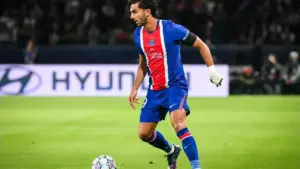
Vitinha is a Portuguese central midfielder, born Vítor Machado Ferreira on 13 February 2000 in Santo Tirso, who plays for Paris Saint-Germain and Portugal. He wears No.17 in Paris and is one of the club’s vice-captains, alongside Achraf Hakimi and Ousmane Dembélé under captain Marquinhos.
He is small, quick-footed and endlessly available, and he plays as the deepest of PSG’s three midfielders: the pivot who receives from the centre-backs, turns away from pressure and starts the attack. Nothing about him photographs well. Watch him for ninety minutes and you understand the team.
Porto, and a loan to Wolves
Vitinha came through the academy at FC Porto, the club he had joined as a boy, and made his senior debut in 2020. That summer he was sent to England on loan to Wolverhampton Wanderers, reuniting with Nuno Espírito Santo in a squad already full of Portuguese talent.
It did not work. He started brightly, faded, lost his place and went back to Portugal after a single season with a handful of Premier League starts to his name. What Wolves supporters remember instead is one goal: a first-time volley from outside the box against Sheffield United, struck so cleanly that it has outlived every other memory of his time in the Midlands.
The season that actually made him came next. Back at Porto in 2021/22 he was the outstanding midfielder in a title-winning side, and by the following summer the bigger European clubs were paying attention.
The PSG transfer — and a difficult first year
Paris signed him in the summer of 2022 for a fee reported at around €40m, after some wrangling over the release clause attached to his contract. He arrived into the final act of PSG’s superstar era: a dressing room containing Lionel Messi, Neymar and Kylian Mbappé, and a team built to accommodate all three rather than to actually play.
His first season was hard. He was quiet, cautious and easily lost in games, and the verdict from a large part of the fanbase was that Paris had spent heavily on a squad midfielder. He was, in the way of many young players who arrive at enormous clubs, being asked to do a job that did not exist in the side he had joined.
How Luis Enrique rebuilt him
Everything changed in 2023. Luis Enrique arrived, the superstars left one by one, and the new manager needed a specific kind of player at the base of his midfield: someone who could take the ball under pressure, absorb a press without panicking, and move the whole team forward twenty yards at a time.
Vitinha was already that player. He simply had never been asked.
Given the role permanently, he became the highest-volume passer in the squad, the man who dictates tempo, and — less obviously — one of the most aggressive ball-winners in Ligue 1. Paris won the Champions League in 2024/25 with him controlling the middle of the pitch, then retained it in 2025/26 to become back-to-back European champions. He was among the leading contenders in the 2025 Ballon d’Or voting, in a year his teammate Ousmane Dembélé won it.
What Vitinha actually does on the pitch
- Receiving on the half-turn. His first touch is almost always taken with his body already open to the pitch. It is the single skill that makes PSG’s build-up possible.
- Escaping the press. He invites opponents onto him, spins out of contact and plays forward. Teams that press Paris high are, in effect, pressing him specifically.
- Pass volume and tempo. He touches the ball more than anybody in the team and decides whether an attack is played at walking pace or at full speed.
- Counter-pressing. The moment Paris lose possession he is the first man back into the ball. His tackle and interception numbers read like a destroyer’s, which is not how most people describe him.
- Shooting from distance. Underused, but real. When space opens twenty-five yards out he takes it, and he strikes a ball beautifully.
The partnership that defines the current side is Vitinha alongside João Neves, with Fabián Ruiz or Warren Zaïre-Emery completing the three. Neves does the covering and the harrying; Vitinha does the thinking.
Vitinha with Portugal
He has been a Portugal international since 2021 and is now a regular in a midfield that has never been short of options. He was part of the squad at Euro 2024 and won the UEFA Nations League with Portugal in 2025, when they beat Spain on penalties in the final in Munich after a 2-2 draw.
For a country that produced Bruno Fernandes, Bernardo Silva and Ruben Neves in the same generation, becoming the man who holds the base of that midfield is not a small achievement.
Vitinha at PSG in 2026/27
He begins this season as the most secure starter in the squad. Paris have reshaped the front line again over the summer — Maghnes Akliouche arrived from Monaco, Ferran Torres from Barcelona, Mika Godts from Ajax and Lucas Digne from Aston Villa, while Gonçalo Ramos, Randal Kolo Muani and Lee Kang-in all left the club — but the midfield has been left almost entirely alone. The full group is in our PSG squad guide for 2026/27.
The start has been uneven: a 1-0 defeat to Lens in the Trophée des Champions, a 2-2 draw away at Rennes to open the Ligue 1 title defence, and a 2-1 UEFA Super Cup win over Aston Villa. Paris now enter the Champions League league phase as holders, chasing a third consecutive European title that no club has managed in the modern format.
If they get anywhere near it, the reason will be standing in front of the centre-backs asking for the ball.
Why Vitinha matters to Paris
PSG spent fifteen years believing European trophies were bought at the top of the pitch. The team that finally won two of them is organised around a slight midfielder from Santo Tirso whose entire job is to make sure the ball keeps moving.
That is the clearest evidence of how completely this club has changed. The most valuable player in Paris is the one who never needs the highlight reel.
Squad and player information is published by Paris Saint-Germain, with fixtures and results confirmed by Ligue 1 and European competition detail at UEFA.