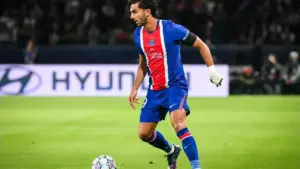
Every May, French football stops arguing for one night and hands out its medals. The Trophees UNFP ceremony is the moment Ligue 1 crowns its player of the season — and unlike almost every other award in the sport, the people doing the crowning are the players themselves.
For Paris Saint-Germain supporters used to seeing their squad swamp the Ballon d’Or shortlists, the UNFP night is the domestic equivalent: narrower, more parochial, and decided by the only jury that has actually had to mark these players in a game. Here is how it works.
What the UNFP actually is
The UNFP — Union Nationale des Footballeurs Professionnels — is not an awards body. It is the French players’ union, founded in 1961 by a generation of footballers who had grown tired of contracts that tied them to clubs for life. Its day job is the unglamorous one: contract disputes, wage protection, insurance, legal support, career advice for players on the way out of the game.
The awards came later, and they remain a sideline to the union’s real function. That origin matters, though, because it explains the voting system. The UNFP is a union of professionals, so its trophies are decided by professionals.
How the Trophees UNFP are voted for
The players of France’s two professional divisions vote. Not journalists, not a panel of former winners, not a public poll — the men and women who spent the season being kicked by the nominees. Managers get a say in their own category.
That single design choice gives the award its character. Peer votes tend to reward the player everyone in the league privately dreaded facing, which is not always the player with the tidiest highlight reel. It also tends to be kinder to midfielders and defenders than a media vote, though a forward with thirty goals will still usually win it, because thirty goals are thirty goals.
The ceremony itself is traditionally staged in Paris towards the end of the season, televised, black tie, and greeted by a portion of the fanbase with the usual eye-roll reserved for footballers in dinner jackets. The winners still turn up.
The awards handed out on the night
The headline prize is Ligue 1 Player of the Year. Around it sit a cluster of others:
- Ligue 1 Player of the Year — the main event.
- Ligue 1 Goalkeeper of the Year — its own category, which is more than most awards nights manage.
- Ligue 1 Young Player of the Year — the one PSG academy watchers care about.
- Manager of the Year.
- Ligue 1 Team of the Year — a full XI.
- Ligue 2 equivalents — player, goalkeeper, young player, manager, team.
- Women’s top-flight awards — player of the year and a team of the season.
- Goal of the season, decided by public vote.
The spread is the point. An awards night run by a union is not going to hand everything to the club with the biggest budget if it can help it, and the Ligue 2 and women’s categories get real airtime rather than a line in the programme.
Why it is not the Ballon d’Or
The two get confused, and they should not be. The Ballon d’Or is global, decided by a jury of journalists, and covers a calendar that stretches across continents and competitions. The Trophees UNFP are domestic, decided by players, and cover one league season in France. A Parisian can have a magnificent European campaign and still lose the UNFP vote to someone who was relentless in Ligue 1 from August to May.
The distinction is worth holding onto this autumn in particular, with PSG’s squad spread across so many international conversations at once. Our list of PSG’s Ballon d’Or winners is a separate lineage entirely from the domestic roll of honour, and the two do not always agree.
The PSG angle
Paris have been the dominant force in the French game for most of the Qatar Sports Investments era, and the UNFP results have broadly reflected that. Kylian Mbappe and Zlatan Ibrahimovic both collected the main prize during their spells at the Parc, and Parisian names have been a fixture in the Team of the Year.
Dominance at an awards ceremony has its own hazard, though: when one club is expected to sweep, the peer vote sometimes becomes the league’s way of saying otherwise. A season in which Paris win everything but lose the individual vote to a player at Monaco, Lille or Rennes is not a snub so much as a signal about how the rest of the league watched the campaign.
That is a live question in 2026/27. Luis Enrique’s side are back-to-back European champions and opened their Champions League defence with a 6-1 win over Slovan Bratislava, yet they are winless in Ligue 1 after three matches and head to Brest still looking for a first domestic victory. If the league form does not turn, the domestic awards may end up telling a very different story about this season than the European ones do.
The short version
The Trophees UNFP are French football’s players’ awards: run by the union, voted for by the professionals in Ligue 1 and Ligue 2, handed out in Paris at the end of the season, and covering both divisions plus the women’s game. They are not the Ballon d’Or, they are not decided by the press, and they are the closest thing the French game has to a verdict from inside the dressing rooms. For more on the bodies that run the competition itself, see our guide to the LFP and how Ligue 1 is governed.
What this desk is not claiming
No 2026 winners, nominees or ceremony date are asserted above; the category list describes the awards as they are habitually structured rather than a confirmed running order for any single year. Mbappe and Ibrahimovic are named as past Ligue 1 Player of the Year winners during their PSG careers; no count, season or ranking is attached to either, and no current PSG player is stated or predicted to have won anything.