Paris Saint-Germain have played in it for more than half a century, dominated it for most of the last fifteen years and are currently sitting in it without a win. Yet for all the coverage the French top flight gets in English, the basic machinery of the competition is rarely spelled out. This is Ligue 1 explained: who runs it, how many clubs are in it, how a team goes up or down, what a title is actually worth in Europe, and where PSG stand in it right now.
Ligue 1 explained: the basics
Ligue 1 is the top division of French professional football. It is organised by the Ligue de Football Professionnel (LFP), the body that also runs Ligue 2, the division below it, and it sits under the authority of the French Football Federation.
Since the 2023/24 season the league has been made up of 18 clubs, reduced from 20 as part of a wider attempt to trim the French calendar. Each club plays every other club twice, home and away, for a total of 34 matches. Three points for a win, one for a draw, and the club top of the table when the fixtures run out is champion of France — no play-off, no grand final. The season runs from August to May with a break over the turn of the year.
When clubs finish level on points, Ligue 1 separates them on goal difference first, then on goals scored. That is worth knowing in a season like this one, where the gap at the top is already being counted in points rather than in form.
The league also carries a title sponsor’s name in its official branding — it has been marketed as Ligue 1 Uber Eats and, more recently, as Ligue 1 McDonald’s. The competition is the same either way; only the commercial wrapper changes.
How promotion and relegation work
The bottom of the table is where the format has most recently changed, and it is unforgiving. The two clubs finishing in the relegation places go straight down to Ligue 2, and the two best sides in Ligue 2 come straight up to replace them.
Above the automatic drop sits a survival match. The club immediately above the relegation zone is not safe: it goes into a promotion/relegation play-off against a side that has come through the upper end of Ligue 2, played over two legs, with the winner taking the Ligue 1 place for the following season. It is the French equivalent of the last parachute on the plane, and it has ended careers and chairmanships alike.
What winning Ligue 1 gets you
Three things, broadly.
The first is the trophy itself — the Hexagoal, the angular silver piece PSG supporters have watched being lifted more often than any other set of fans in the country. Our guide to how many Ligue 1 titles PSG have won has the full tally and how it compares with the rest of France.
The second is European football. France’s allocation of places in UEFA competition is not fixed: it moves with the country’s coefficient, which is why the number of French clubs in the Champions League has changed more than once in recent seasons. The general shape is that the leading finishers enter the Champions League, the next places lead into the Europa League and the Conference League, and the winners of the Coupe de France take a European place of their own. The exact 2026/27 allocation is not something we will state here without a current UEFA source.
The third is a fixture in August. The Ligue 1 champion meets the Coupe de France winner in the Trophée des Champions, France’s season-opening super cup — a match PSG lost 1-0 to Lens this year, which is a reminder that domestic pre-eminence guarantees nothing on the day.
The rules that make French football different
Two features of Ligue 1 have no exact equivalent in the Premier League or La Liga, and both come up constantly in transfer coverage.
The first is the DNCG, the LFP’s independent financial watchdog. It audits every professional club’s accounts and has real teeth: it can impose a transfer ban, a wage cap, or relegation on a club whose books do not stand up, before a ball has been kicked. Clubs in France are policed on their spending in a way English clubs historically were not.
The second is the joker transfer — the mechanism that lets a French club register a replacement outside the normal window under specific conditions. It is why you see French sides signing players in September while everyone else has shut up shop, and it is a recurring feature of the Ligue 1 news cycle each autumn.
Where PSG sit in Ligue 1 right now
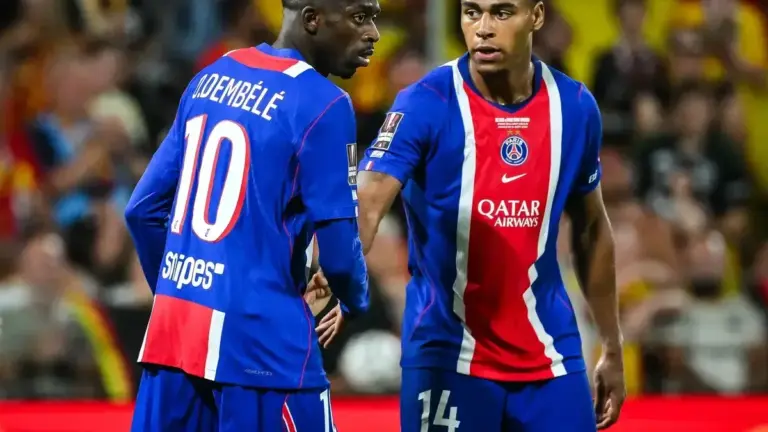
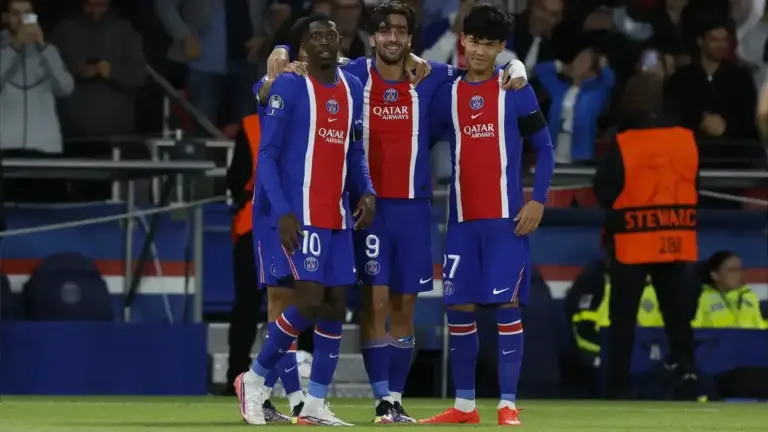
Awkwardly, is the honest answer. Three games into the 2026/27 campaign, Luis Enrique’s side are still without a league win: a 2-2 draw away at Rennes on the opening weekend, a 2-2 draw at Lille in which captain Marquinhos headed a late equaliser, and then a 2-1 home defeat to Monaco at the Parc des Princes.
Monaco lead the table. Get French Football News reported on 8 September that PSG were seven points behind them, and Filipe Luís’s side arrived in Paris unbeaten in five with the best defence in the division. Round 4 sends PSG away to Brest, a fixture previewed in full in our Brest v PSG guide.
The context worth holding on to is that this is a club whose European form has been the opposite of its league form: back-to-back Champions League holders who opened the defence of the trophy with a 6-1 win over Slovan Bratislava at the Parc on 9 September. Under Luis Enrique, PSG have tended to treat the opening weeks of a season as an extended pre-season. Whether 34 rounds of Ligue 1 leave room for that this year is the question the autumn will answer.
What is not asserted here
Deliberately left out: France’s precise UEFA allocation for the current cycle, the exact prize-money distribution, the identity of the league’s broadcasters in any territory, and the current squad-registration and homegrown-player quotas. Those details change season to season and are not verified in our records, so they are not stated above. Official competition information is published by the LFP at Ligue1.com, and French-language coverage translated into English is available from Get French Football News.