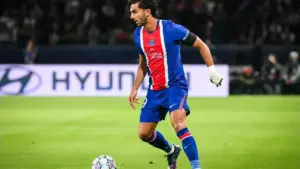
Paris Saint-Germain lifted the UEFA Super Cup in August 2026, and the trophy has been namechecked in Parisian conversation ever since — usually without anybody stopping to explain what it actually is. It is not a friendly, it is not a pre-season warm-up, and it is not handed out for finishing high in a domestic league. It is a one-off European final, played once a year, and for Les Parisiens it is currently the only piece of silverware in the 2026/27 cabinet.
So here is the explainer: what the competition is, how clubs get into it, when and where it is played, what Paris have done in it, and why a single match in the middle of August carries more weight than the calendar suggests.
What the UEFA Super Cup actually is
The UEFA Super Cup is a single match between the winners of UEFA’s two flagship club competitions. It is European football’s season opener: the reigning Champions League holders against the reigning Europa League holders, ninety minutes, extra time and penalties if required, no second leg and no replay. The winners get the trophy on the night.
The idea dates back to the early 1970s, when it began as an unofficial contest before UEFA formally adopted it. For most of its history the Champions League winners faced the holders of the Cup Winners’ Cup; when that competition was absorbed at the end of the 1990s, the UEFA Cup — later rebranded as the Europa League — took the second slot. The format has barely changed since. Two teams, one game, one trophy.
How clubs qualify for it
This is the part that is most often got wrong. You do not qualify for the UEFA Super Cup by finishing well in your domestic league, and you do not qualify by reaching the Champions League group or league phase. You qualify by winning a European trophy. There are exactly two places, and both are earned on a European final night the previous season.
That is why the field is always tiny and always elite, and why the same names recur. It also means a club can dominate its own country for a decade and never appear. For PSG, the route was straightforward: retaining the Champions League in 2025/26 put them straight into the following August’s fixture as holders.
When and where the match is played
The Super Cup is played in August, before the domestic leagues have properly settled and usually before the Champions League league phase has begun. For much of its modern history it had a fixed home — a standing venue on the Mediterranean coast — but UEFA moved to a rotating host system, awarding the match to a different city each year in much the same way it awards a Champions League final. That makes it a genuine neutral-venue occasion rather than a home tie for either side.
The timing is the reason it gets treated as a curtain-raiser. Squads are still short of rhythm, new signings are days old, and managers are frequently picking sides that will look nothing like the one they field in March. Which is exactly why the result tends to say less about a season than supporters want it to.
PSG and the UEFA Super Cup
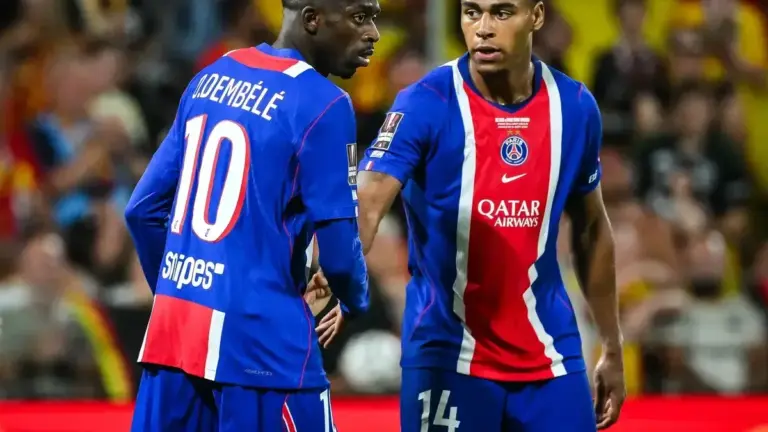
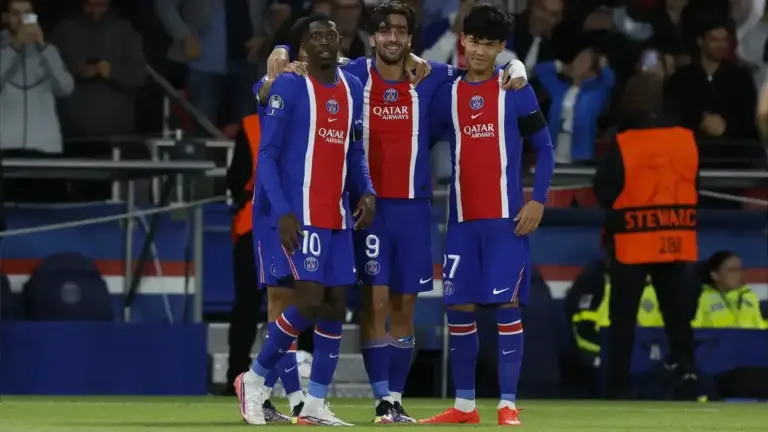
Paris won the 2026 edition, beating Aston Villa 2-1 on 13 August 2026. It was the club’s second UEFA Super Cup, and it remains the only trophy Luis Enrique’s side have added so far this season — the Trophée des Champions was lost 1-0 to Lens, and the opening weeks of the Ligue 1 campaign brought draws at Rennes and Lille followed by a defeat to Monaco.
One detail is worth clearing up, because it has tripped up plenty of match reports. Lucas Digne was a Paris Saint-Germain player on the night, not an Aston Villa one: his move back to the capital was completed on 10 August 2026, three days before the final. He arrived from Villa, and then the fixture list handed his former club straight back to him.
Who has won it most often
Because entry is restricted to European trophy winners, the honours list is dominated by the continent’s serial winners. Real Madrid, Barcelona and AC Milan are the most decorated clubs in the competition’s history, with Liverpool, Bayern Munich and Atlético Madrid among the other repeat visitors. Sides who win a European trophy for the first time often find the Super Cup is their first taste of a genuinely global one-off occasion.
For a club like PSG, whose European history was thin until very recently, appearing in it twice in two years is a marker of how quickly the landscape has shifted. It is the direct by-product of back-to-back Champions League titles, and it is the kind of fixture that simply was not available to the club for most of its existence.
Does the Super Cup actually matter?
Depends who you ask, and it always has. To a manager it is a competitive run-out with a trophy attached — useful minutes, real intensity, no dead rubber. To a squad that has just won a European trophy it is a chance to put a second one on the shelf before the hard part of the season starts. To supporters it is a night out in a neutral city in August, and a reminder of what the previous May earned.
The honest read is that nobody’s season is judged on it. But nobody turns it down either, and Paris will not be handing theirs back. For a club chasing a third consecutive Champions League — something only a handful of clubs in the entire history of the European Cup have ever managed — the Super Cup is the trophy that confirms you belong in the conversation. Full competition detail, including the current host city rotation, is published by UEFA.