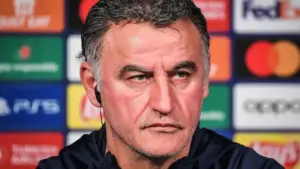
Ask a casual observer who runs Paris Saint-Germain and you will get one of two answers: Luis Enrique, or Qatar. Neither is quite right. The man who has held the club’s steering wheel for a decade and a half is Nasser Al-Khelaifi — a former professional tennis player from Doha who is now one of the most powerful executives in world football.
He is PSG’s president. He is also a television magnate, a UEFA committee member and the chairman of the body that represents Europe’s clubs. Here is who he is, how he got the job, and what he has actually changed at the Parc des Princes.
Who is Nasser Al-Khelaifi?
Nasser Ghanim Al-Khelaifi was born in Doha in November 1973. He is the chairman and chief executive of PSG, the chairman of Qatar Sports Investments (QSI), and the chairman of beIN Media Group, the Qatari broadcaster that holds football rights across dozens of markets.
That combination — owning a club, chairing the fund that bought it, and running a broadcaster that pays for the football — is why his name appears far more often in boardroom stories than in team news. He is not a coach and never has been. His influence is structural.
From the tennis tour to Qatari sport
Before any of it, he was an athlete. Al-Khelaifi played professional tennis, representing Qatar in Davis Cup competition, and by his own repeated admission he was not a great one — he has joked publicly about his ranking more than once. The playing career mattered anyway, because it put him inside Qatari sports administration early.
He became president of the Qatar Tennis Federation and helped build Doha’s calendar of international events, and that administrative track — rather than any football pedigree — is what led to the media and investment roles that followed. It is worth holding on to when assessing him: he came to football from sport as an industry, not from the dressing room.
How he became PSG president
QSI completed its takeover of Paris Saint-Germain in 2011, buying a club that had won the French title twice in its history and had spent the previous decade drifting between mid-table and crisis. Al-Khelaifi was installed as president that year and has held the role ever since.
The scale of the change is best measured by what came after rather than by what was spent. Domestic dominance arrived almost immediately — you can read the full tally in our guide to how many Ligue 1 titles PSG have won — while the European breakthrough took far longer, and cost him a decade of criticism in the meantime.
The galactico years, and the correction
For most of the 2010s, the QSI model was straightforward: buy the biggest name available. It produced some of the largest transfers ever recorded and some of the most famous shirts in the sport, and it did not produce a Champions League.
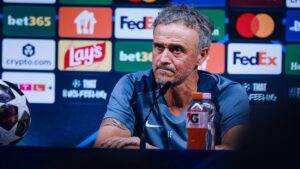
The correction is the most interesting part of Al-Khelaifi’s presidency, because it required abandoning the strategy that had defined it. PSG moved away from assembling superstars and towards a younger, coachable squad built around a manager with real authority over selection. Luis Enrique was appointed in July 2023 and given exactly that. Recruitment was handed to football advisor Luis Campos, a trader of young players rather than a buyer of finished ones.
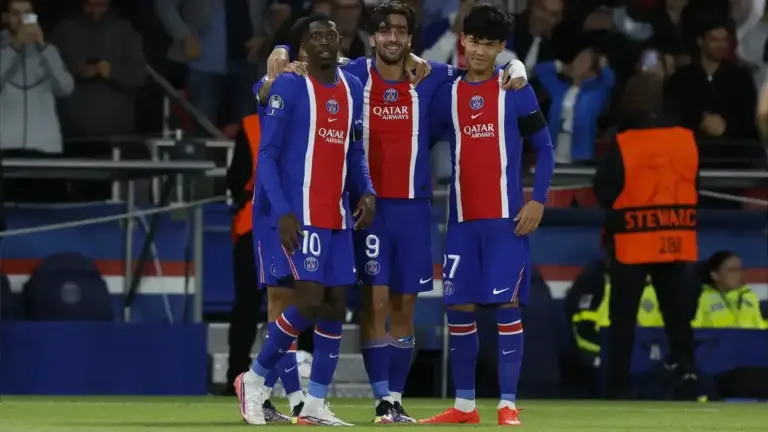
It worked. PSG won the Champions League in 2024/25 and retained it in 2025/26, making them one of only nine clubs ever to defend the European Cup and only the second to do it in the Champions League era, after Real Madrid. The club added the 2026 UEFA Super Cup, beating Aston Villa 2-1, for a second European Super Cup.
Beyond Paris: beIN, the ECA and UEFA
Al-Khelaifi’s football power does not stop at the Parc. He has chaired the European Club Association since 2021, which makes him the formal voice of Europe’s clubs in negotiations with UEFA over the calendar, competition formats and prize money. He also sits on UEFA’s executive committee.
He arrived in the ECA chair in unusual circumstances. The breakaway European Super League collapsed within days of its launch in April 2021, its leading figures resigned, and Al-Khelaifi — who had refused to join and had publicly opposed it — stepped into the vacuum. PSG’s decision not to sign up remains the single most consequential political call of his presidency, and it is the reason he is now inside the governance of the sport rather than outside arguing with it.
Critics point out, reasonably, that the same man negotiates broadcast deals through beIN, represents clubs through the ECA, sits on UEFA’s board and runs a club competing in UEFA’s competitions. Supporters counter that PSG stayed loyal to the existing structure when the wealthiest clubs in England, Spain and Italy did not. Both things are true at once.
What his PSG looks like in 2026/27
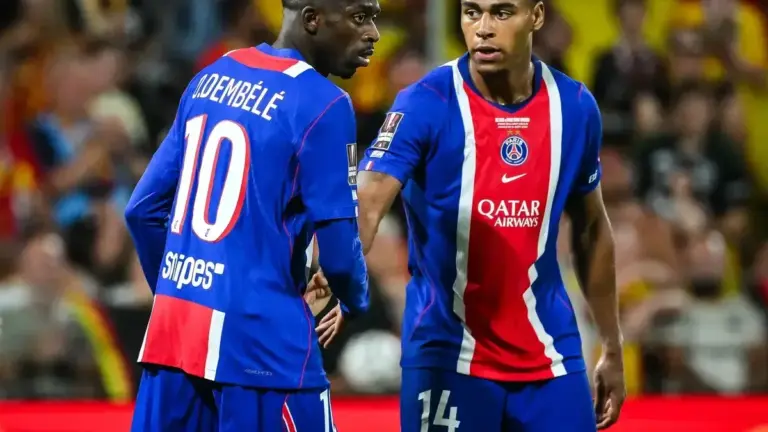
The current season has been an awkward one to follow a season of European success. PSG lost the Trophée des Champions 1-0 to Lens and have started Ligue 1 without a win in three games: 2-2 at Rennes, 2-2 at Lille and a 2-1 home defeat to Monaco, who lead the table. The Champions League defence began far more convincingly, with a 6-1 win over Slovan Bratislava at the Parc on 9 September, Ferran Torres scoring a hat-trick and Ousmane Dembélé two.
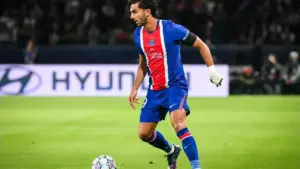
Squad-wise, this is still recognisably an Al-Khelaifi-era PSG in its newer form: Bradley Barcola and Ibrahim Mbaye sold for large fees in the closing days of the 2026 window, Torres and Maghnes Akliouche brought in, and the spine — Marquinhos, Vitinha, Dembélé, Khvicha Kvaratskhelia, Achraf Hakimi — left intact. Players are now allowed to leave. That, more than any signing, is the marker of the shift.
The bottom line
Nasser Al-Khelaifi is the longest-serving major figure at Paris Saint-Germain and the one constant across every phase of the club’s modern history, from the 2011 takeover to back-to-back European titles. He spent ten years being told that money could not buy a Champions League, then won two in a row after changing almost everything about how the club spent it.
For the ownership structure behind him, read our explainer on who owns PSG and how Qatar Sports Investments works. Official club information is published at PSG.fr, and the European Club Association’s own record of his chairmanship is at ECAEurope.com.